Claude Haiku 5.5 is Anthropic’s latest small model, released on October 7, 2026. Anthropic positions it as the cheapest, fastest, and most capable Haiku-class model it has shipped—built for high-volume, cost-sensitive work rather than as a drop-in replacement for Opus or Sonnet on heavy reasoning jobs.
If you searched for haiku 5.5, you usually want three answers: what it is, how it is priced (including the ≤100k vs >100k prompt tiers), and when to pick it versus Sonnet or Opus. Below are those details from Anthropic’s official launch page and Claude Platform docs.
What is Claude Haiku 5.5?
Haiku 5.5 sits at the fast/cheap end of the Claude 5.5 family. Anthropic says it is designed for quick, repetitive workloads such as:
- Summarization and compaction
- Classification, extraction, and routing
- Database-style lookups and high-volume text tasks
- Subagents that support a larger model (for example Opus 5.5 or Sonnet 5.5) on coding or agent workflows
- Latency-sensitive experiences such as live customer support and browser use
It is the first Haiku-class model with an adjustable effort setting, so teams can tune cost versus intelligence per task. Adaptive thinking is on by default and steered with the effort parameter (default effort on the Claude API: medium).
Anthropic’s own guidance still points complex coding and deep knowledge work to larger models—Opus 5.5 as the daily driver for hard work, Sonnet 5.5 for well-scoped tasks—while Haiku 5.5 covers speed and volume.
Key developer specs
| Item | Detail |
|---|---|
| Model ID (Claude API) | claude-haiku-5-5 |
| Also listed as | Amazon Bedrock anthropic.claude-haiku-5-5; Google Cloud / Microsoft Foundry / Claude Platform on AWS: claude-haiku-5-5 |
| Released | October 7, 2026 |
| Context window | 1M tokens |
| Max output | 128K tokens (up to 300K on Message Batches API with the documented beta header) |
| Thinking | Adaptive; effort controls |
| Comparative latency | Fastest in Anthropic’s published lineup comparison |
| Reliable knowledge cutoff | June 2026 |
| Inputs → outputs | Text and images → text |
| Retirement commitment | Not sooner than October 7, 2027 (per model overview) |
Tokenizer note: Haiku 5.5 uses the newer tokenizer shared with Claude 4.7 and later models. The same text counts as approximately 30% more tokens than on earlier Haiku models (for example Haiku 4.5). Factor that in when you estimate cost.
Pricing tiers: ≤100k vs >100k
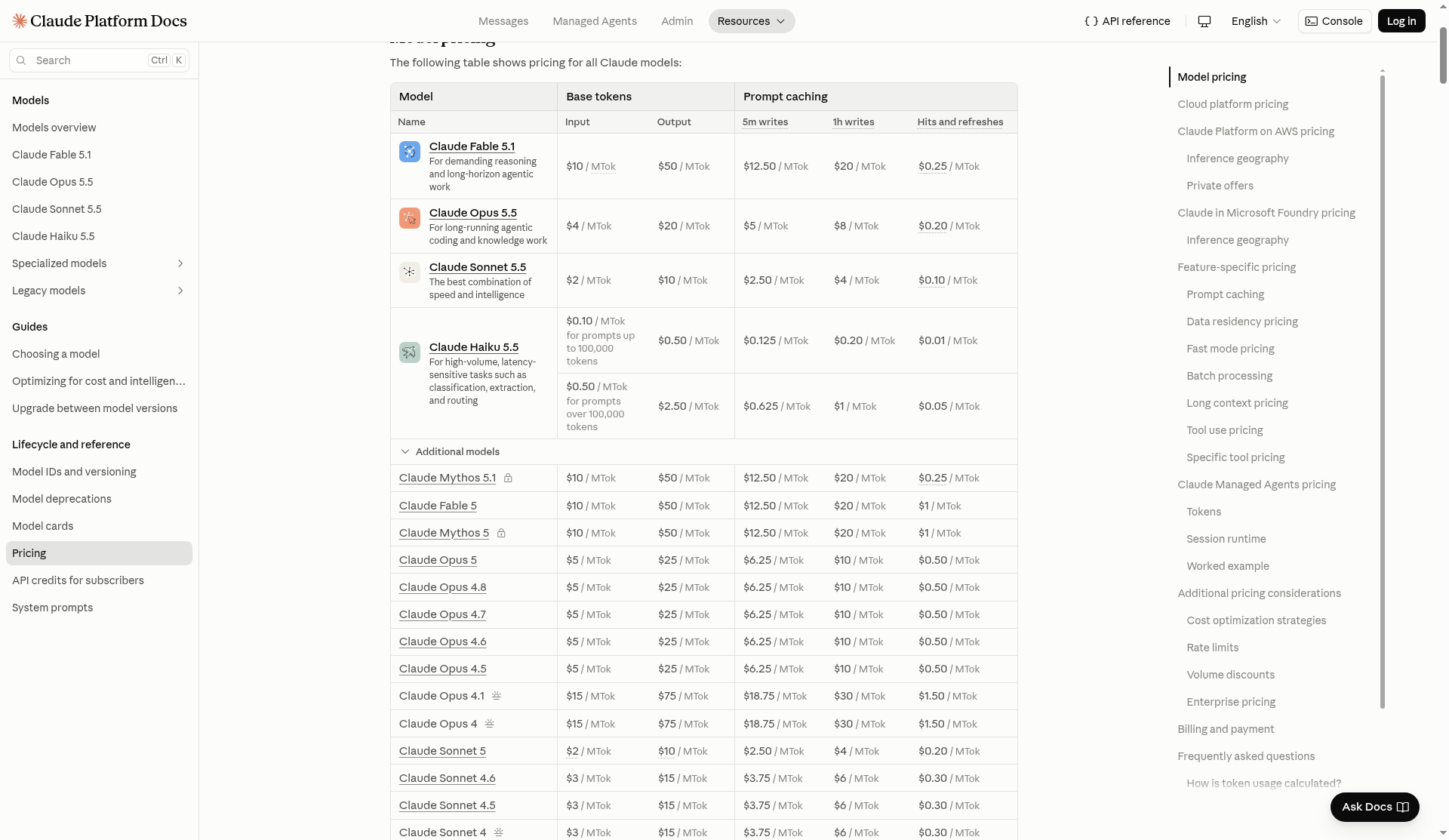
On the Claude Platform, Haiku 5.5 is priced by prompt length. A request’s prompt length counts all of its input tokens, including cache reads and cache writes. Each request is priced on its own.
| Price per 1M tokens (MTok) | Prompts up to 100,000 tokens | Prompts over 100,000 tokens |
|---|---|---|
| Input | $0.10 | $0.50 |
| Output | $0.50 | $2.50 |
| Cache reads | $0.01 | $0.05 |
| 5-minute cache writes | $0.125 | $0.625 |
| 1-hour cache writes | $0.20 | $1.00 |
Batch API requests are 50% off input and output on both tiers (for example $0.05 / $0.25 per MTok input/output on the ≤100k tier).
Anthropic’s launch post states Haiku 5.5 is priced about 90% lower than Haiku 4.5 for requests up to 100,000 tokens and 50% lower for requests over 100,000 tokens, and that on average it costs around 75% less to run—reflecting that most prior Haiku traffic fell in the short-prompt bucket, plus tokenizer differences.
For comparison on the short-prompt (≤100k) tier versus neighbors (base input / output per MTok from Anthropic’s pricing docs and launch table):
- Haiku 5.5 (≤100k): $0.10 / $0.50
- Haiku 4.5: $1.00 / $5.00
- Sonnet 5.5: $2.00 / $10.00
Free, Pro, Max, Team, and Enterprise users can select Haiku 5.5 on Claude.ai (web, iOS, Android). It is also available in Claude Code and on Amazon Web Services, Google Cloud, and Microsoft Foundry.
When to use Haiku 5.5 vs Sonnet / Opus
Use Anthropic’s own framing:
- Prefer Haiku 5.5 when speed and volume matter—summaries, classification, routing, compaction, cheap subagents, live support, and browser/desktop automation loops. Keep most prompts under 100k tokens when you want the lowest published rates.
- Prefer Sonnet 5.5 for well-scoped production work that needs more intelligence than Haiku while staying faster/cheaper than Opus.
- Prefer Opus 5.5 (or other frontier models in the lineup) for complex agentic coding and hard knowledge work where a wrong answer is expensive.
Anthropic notes that Sonnet 5.5 and Opus 5.5 remain better choices for complex agentic coding suites such as Terminal-Bench-style tasks, while Haiku 5.5 unlocks narrowly scoped work that used to be cost-prohibitive.
Selected launch benchmarks (Anthropic)
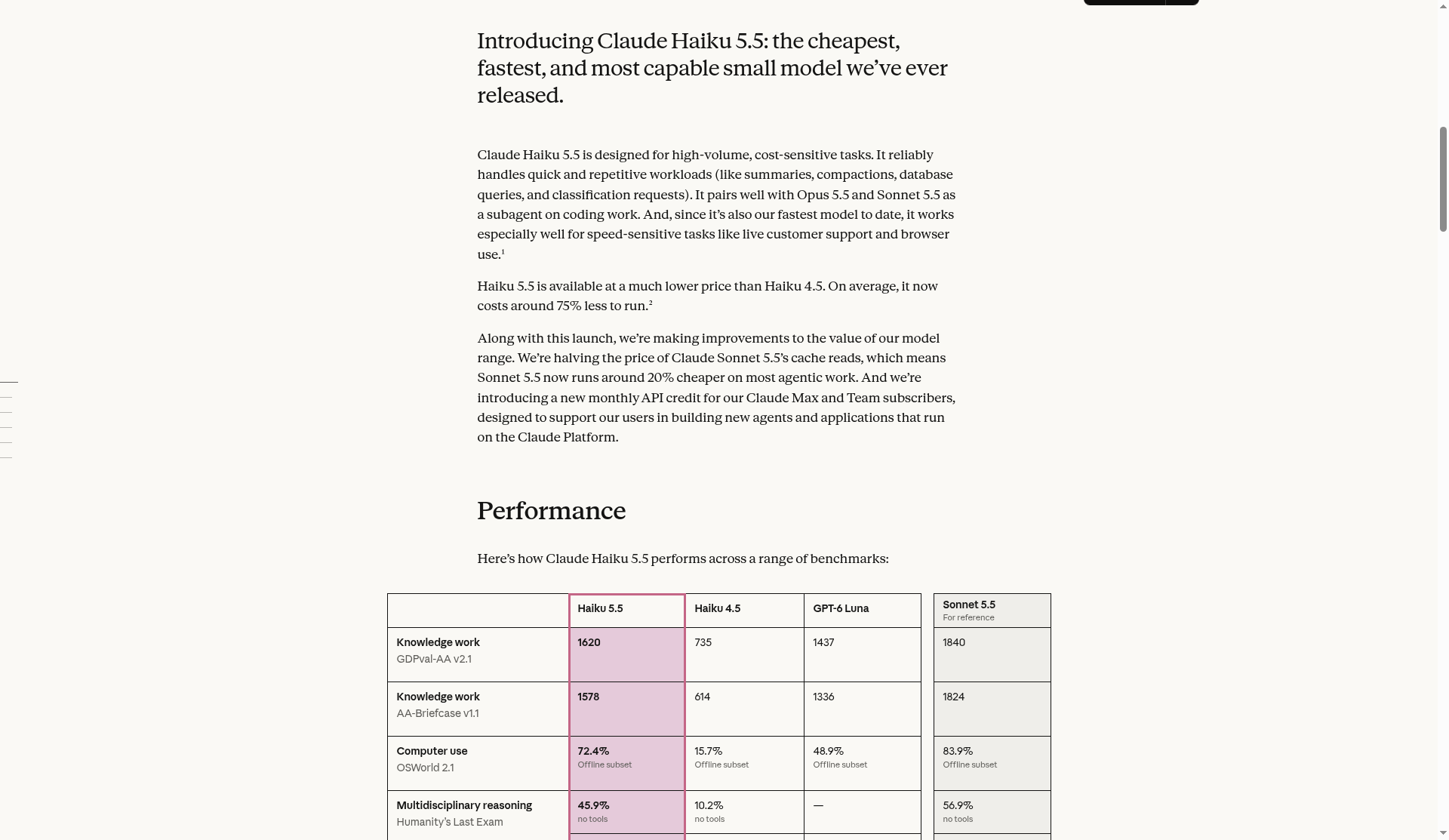
Figures below are from Anthropic’s October 7, 2026 launch page (not independent re-tests):
| Benchmark | Haiku 5.5 | Haiku 4.5 | Sonnet 5.5 (reference) |
|---|---|---|---|
| GDPval-AA v2.1 | 1620 | 735 | 1840 |
| AA-Briefcase v1.1 | 1578 | 614 | 1824 |
| OSWorld 2.1 (offline subset) | 72.4% | 15.7% | 83.9% |
| Humanity’s Last Exam (no tools) | 45.9% | 10.2% | 56.9% |
| Terminal-Bench 4.0 | 39.2% | 0.0% | 70.6% |
| FrontierCode 1.1 (Main) | 46.4% | — | 52.1% (Xhigh) |
| Chartography (no tools) | 46.4% | 6.4% | 61.6% |
Takeaway: Haiku 5.5 is a large jump over Haiku 4.5 on the published scores, while Sonnet/Opus still lead on the hardest agentic coding evaluations.
How to try claude-haiku-5-5
- On Claude.ai, pick Haiku 5.5 in the model picker (Free / Pro / Max / Team / Enterprise).
- Via the Claude API, call model ID
claude-haiku-5-5. - On cloud platforms, use the IDs listed in the specs table (Bedrock, Google Cloud, Microsoft Foundry, Claude Platform on AWS).
- Read Anthropic’s migration guide when moving from Haiku 4.5—tokenizer behavior and thinking / sampling parameter rules differ (platform docs advise omitting
temperature,top_p, andtop_kfor this model family where those values return errors).
Cost-control checklist for teams
If you plan to roll Haiku 5.5 into production agents, Anthropic’s docs and launch materials point to a few practical controls:
- Keep high-volume prompts in the ≤100k tier whenever possible so you stay on the $0.10 / $0.50 MTok rates.
- Use prompt caching for repeated system prompts and tool schemas; cache reads on the ≤100k tier are $0.01 per MTok.
- Use the Batch API for asynchronous jobs when latency is flexible (50% off input and output).
- Steer adaptive thinking with the effort parameter instead of always defaulting to maximum intelligence.
- Remember the newer tokenizer: the same text may consume ~30% more tokens than on Haiku 4.5, which affects both cost and context packing.
FAQ
What is the exact model ID?
claude-haiku-5-5 on the Claude API (and matching IDs on partner clouds as documented above).
Why are there two prices?
Prompts up to 100,000 tokens use the lower rates; prompts over 100,000 tokens use the higher rates. Prompt length includes cache reads and writes for that request.
Is Haiku 5.5 cheaper than Haiku 4.5?
Yes, per Anthropic: about 90% lower on the ≤100k tier, 50% lower on the >100k tier, and around 75% cheaper on average given historical traffic mix (with tokenizer caveats).
Should I replace Sonnet with Haiku 5.5?
Only for high-volume, narrowly scoped, latency-sensitive work. Keep Sonnet/Opus for complex coding and high-stakes reasoning.
Sources verified Oct 14, 2026 (Pacific Time): anthropic.com/claude-haiku-5-5; anthropic.com/claude/haiku; Claude Platform pricing; Haiku 5.5 model overview.