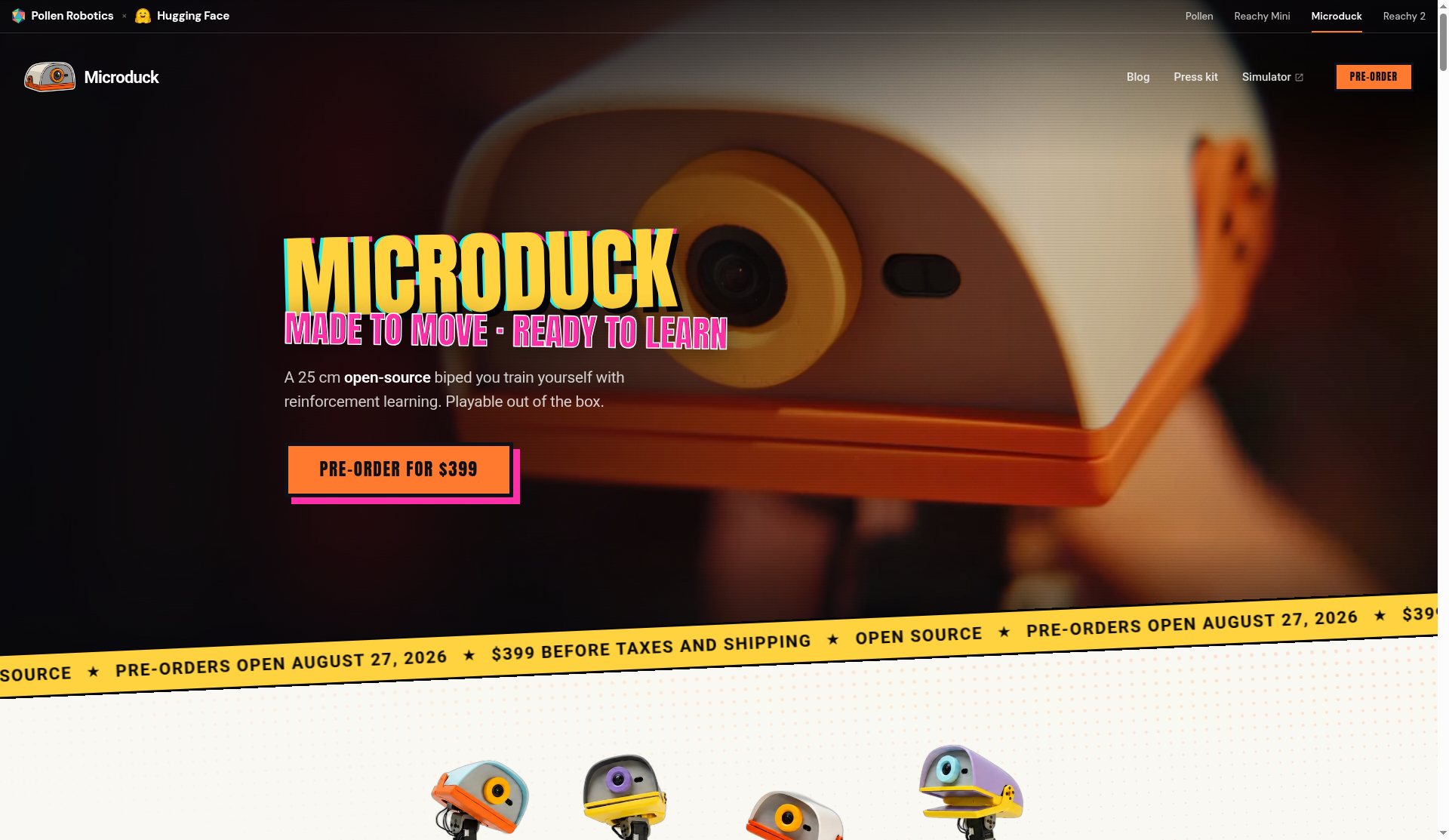
Microduck is a roughly 25 cm biped robot from Pollen Robotics—the Bordeaux robotics team at Hugging Face—meant for playful desk use and hands-on reinforcement learning. Vendor list price is $399 before taxes and shipping; pre-orders opened August 27, 2026, with first deliveries targeted before Christmas 2026 in North America and Europe. Searches for nvidia micro duck or Microduck usually want the hardware specs, the open-source software stack (not open hardware), and how NVIDIA Isaac Lab fits the sim-to-real training path.
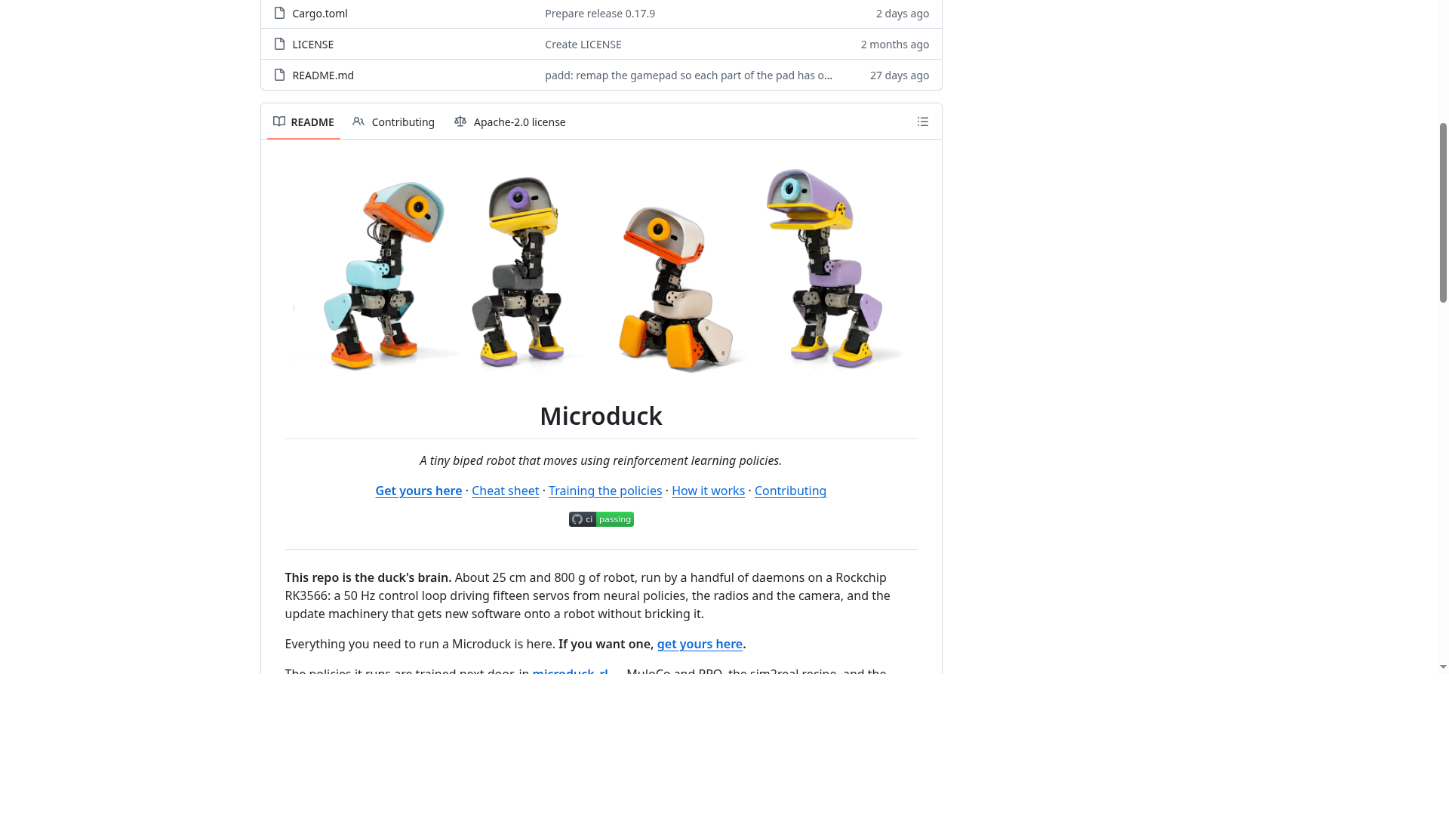
This explainer summarizes the public product page and press kit at pollen-robotics.com/microduck, the repository at pollen-robotics/microduck, and the Hugging Face / NVIDIA developer blog on Isaac Lab 3.0. Specs and launch dates below are vendor-published; treat provisional camera/LiDAR details as unfinished until Pollen says otherwise.
What Microduck is
Microduck is Pollen’s second consumer robot after Reachy Mini: a waddling biped with a grasping beak, shipped playable out of the box (game controller included) and designed so you can retrain behaviours in simulation and deploy them on the real duck. The press kit’s “why it matters” line is approachability—complex behaviours onboard, then an open stack for control, simulation, RL training, and sim-to-real transfer.
Vendor-described onboard moves at launch include walk, sit & stand, kick, grab (beak scoop), roller skating when skates are equipped, and get-back-up from common falls—seven trained policies in the box, per the product and press materials.
Specs and price (vendor)
- Size / weight: about 25 cm tall, 14 cm wide; under 800 g
- Actuation: 15 motors (degrees of freedom across legs, head, and neck); articulated grasping beak
- Sensing: front camera (with a visible “camera in use” indicator), compact LiDAR (described as an 8×8 time-of-flight matrix), two IMUs (body + head)
- Compute: Rockchip RK3566 with AI accelerator; 1 GB RAM; 32 GB storage
- Policy loop: 50 Hz onboard (vendor)
- Connectivity / audio: Wi-Fi and Bluetooth; microphones and speaker; NFC antennas in head and beak
- Battery: removable NP-F550 (2600 mAh); around one hour of runtime depending on use (vendor estimate)
- Price: $399 introductory, before taxes and shipping
- Colourways: Cream, Graphite, Lavender, Sky
The press kit flags camera resolution and field of view, LiDAR range, radio versions, SDK languages, and any age recommendation as not final yet.
Open-source software—not open-source hardware
Marketing calls Microduck “open source,” and the press kit is explicit about what that means: the software stack (SDK, simulation, RL training tools, sim-to-real workflow) is open—Apache-2.0 on the product page—while mechanical and electronic design files are not. Do not describe it as open-source hardware. The GitHub project is at github.com/pollen-robotics/microduck; the product page also highlights MuJoCo for the physics sim used in their own training story.
How to pre-order / buy
Pre-orders opened August 27, 2026 via the official site. Launch markets are North America and Europe; first deliveries are targeted before Christmas 2026—not a hard guarantee. Optional charger and accessory packs are listed separately from the base robot. For press or review units, Pollen points to [email protected].
NVIDIA Isaac Lab and the “nvidia micro duck” angle
The Hugging Face blog Train in Simulation, Deploy on a Real Robot: Microduck with Isaac Lab 3.0 (published October 21, 2026) walks through training a walking policy in NVIDIA Isaac Lab with Newton, evaluating it in sim, exporting policy.onnx, and loading it on a configured Microduck. That workflow needs a Linux workstation with a supported NVIDIA GPU for training; deployment needs a working robot and control interface.
Highlights from that tutorial (project-reported, not independent benchmarks): ready Microduck tasks in Isaac Lab (flat and rough terrain), parallel GPU environments, backlash/actuator modeling and domain randomization for sim-to-real, ONNX handoff to the robot’s onboard runtime, sharing on the Hugging Face Hub, and optional validation in Microduck Arena. Walking is framed as the starting point; the same Isaac Lab 3.0 stack is positioned for rougher locomotion and perception experiments later.
In short: Microduck is the hardware/software platform from Pollen / Hugging Face; NVIDIA Isaac Lab is one supported high-end path to train and transfer policies—especially relevant when people search “nvidia micro duck.”
Who it is for
- Learners and hobbyists who want a small biped that walks and grabs out of the box, then invites RL experiments
- Students and labs exploring sim-to-real without a six-figure robot budget (at the vendor’s $399 list price)
- Developers already in the Hugging Face / Isaac Lab ecosystem who want a physical target for ONNX locomotion policies
Caveats
- Software ≠ hardware openness: open SDK/sim/RL stack; closed mechanical/electronics design files
- Delivery is a target: “before Christmas 2026” is vendor intent for first units, not a promise
- Some sensing/SDK details still provisional per the press kit
- Isaac Lab training assumes a capable NVIDIA GPU workstation; the duck itself is playable without that path
- Runtime ~1 hour is vendor-estimated and use-dependent
- This is not a hands-on lab review—claims above track public pages as of verification
Sources
- Microduck product page (Pollen Robotics)
- Microduck press kit
- GitHub: pollen-robotics/microduck
- Hugging Face blog: Microduck with Isaac Lab 3.0 (sim-to-real)
Sources verified Oct 27, 2026 (Pacific Time)