Grok Voice 3.0 is SpaceXSI’s newest speech-to-speech model for real-time voice agents. Announced on October 14, 2026, it is available in the Voice Agent API under the model id grok-voice-3.0, at the same price as Grok Voice 2.0: $0.08 per minute ($4.80 per hour).
If you searched for Grok Voice 3.0 because you build customer-support bots, in-car assistants, or any hands-free voice agent, this guide walks through what the release claims, how pricing and aliases work, who it is for, and what to watch when you upgrade—based on the official launch post, developer docs, and contemporaneous press.
What Grok Voice 3.0 is
Unlike a classic “transcribe, then reply in text, then synthesize speech” pipeline, Grok Voice 3.0 is positioned as a true speech-to-speech model: audio in and audio out, aimed at natural turn-taking. SpaceXSI’s announcement calls it “the world’s most intelligent speech-to-speech model,” highlights class-leading latency “at under one second,” and says Grok Voice already powers millions of conversations a day across Tesla and SpaceX.
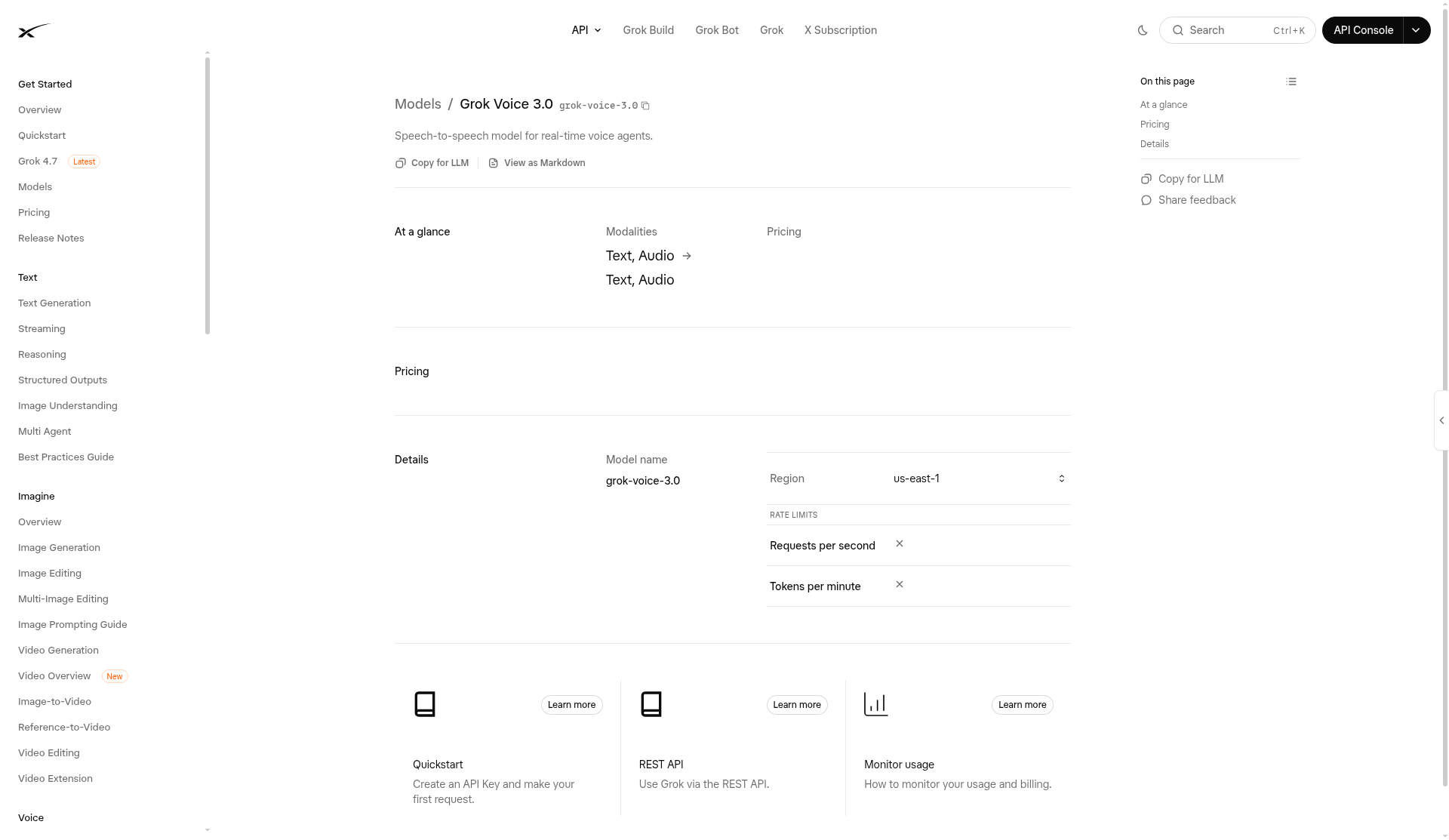
Developer documentation lists the model name as grok-voice-3.0 and describes it as a speech-to-speech model for real-time voice agents. The model page lists availability in regions including us-east-1, eu-west-1, and us-saltlake-2.
SpaceXSI’s October developer release notes state that Grok Voice 3.0 is available with Speech to Speech at the same price as Grok Voice 2.0, that the API is unchanged, and that sessions using the grok-voice-latest alias are upgraded automatically.
Benchmarks SpaceXSI cites
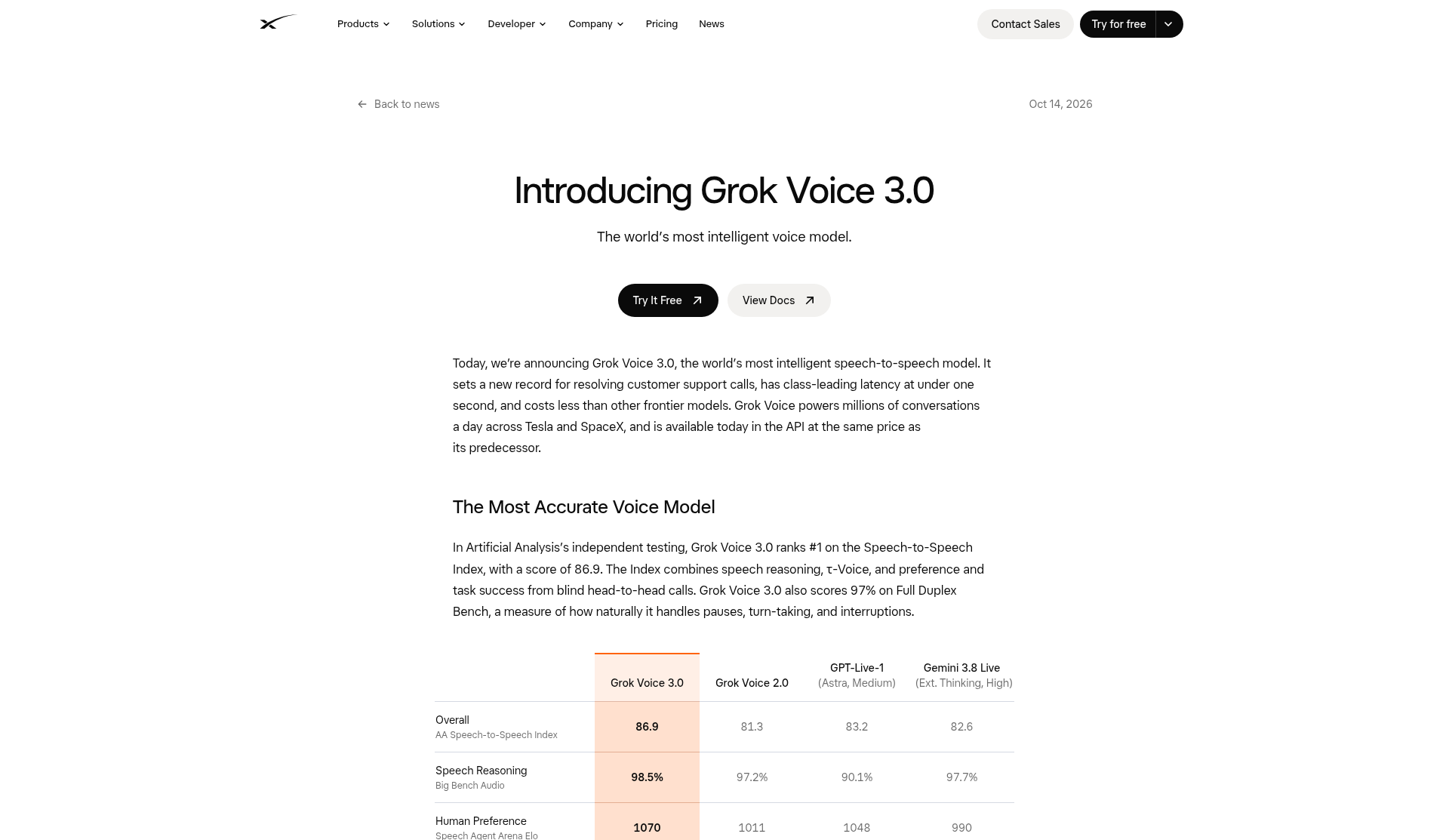
The launch post cites independent testing from Artificial Analysis (table source dated October 13, 2026). According to SpaceXSI’s announcement:
- Overall AA Speech-to-Speech Index: 86.9 for Grok Voice 3.0, versus 81.3 for Grok Voice 2.0, 83.2 for GPT-Live-1 (Astra, Medium), and 82.6 for Gemini 3.8 Live (Ext. Thinking, High)
- Full Duplex Bench: 97.0% — how naturally the model handles pauses, turn-taking, and interruptions
- Speech Reasoning (Big Bench Audio): 98.5%
- Human Preference (Speech Agent Arena Elo): 1070
- Task Completion (Task Success Rate): 94.8%
- τ-Voice: 71.6% on support-style calls with diverse accents, background noise, and interruptions; SpaceXSI says this is comparable with GPT-Live-1 (Astra) but at about 40% lower latency in that comparison
The same post says Grok Voice 3.0 achieved the highest accuracy score at 74% on ServiceNow’s open-source EVA-Bench (200+ realistic enterprise scenarios) and was the best-performing model when accuracy and customer experience were scored together. ServiceNow’s Nitin Aggarwal is quoted saying the model “pairs top accuracy with a natural, responsive conversation.”
SiliconANGLE’s October 14, 2026 report repeats the 86.9 Speech-to-Speech Index lead and notes Artificial Analysis’ Big Bench Audio cost-per-task figures cited in coverage (about 2.5 cents on Grok Voice 3.0 versus higher figures for some competing setups). Treat all of these as vendor-reported or third-party benchmark claims; check Artificial Analysis and ServiceNow directly for methodology and updates.
Pricing and availability
According to SpaceXSI’s announcement and SiliconANGLE:
- List price: $0.08 / min ($4.80 / hr)—unchanged from Grok Voice 2.0
- Where: Voice Agent API, available on announcement day
- Alias behavior:
grok-voice-latestnow points togrok-voice-3.0; agents already on the alias were switched with no code changes required
Release notes also confirm that grok-voice-2.0 is deprecated. To upgrade pinned deployments, set model to grok-voice-3.0 or grok-voice-latest at the same price. (A separate note in the same October notes covers speech-to-text model churn—for example grok-voice-transcribe-1.0 end-of-life routing—which is related voice stack housekeeping but not the same as the speech-to-speech 3.0 launch.)
Where SpaceXSI says it is already used
The announcement describes production use at Tesla and Starlink:
- Tesla vehicles: millions of Grok Voice conversations a day; Connectors for lighter hands-free tasks (calendar, email) and Grok Bot for bigger tasks; Grok Bot’s voice mode also runs on Grok Voice 3.0
- Starlink call centers: about 20,000 customer calls a day across multiple languages; roughly 70% resolved with no human in the loop; one in four sales calls ends in a purchase before the caller hangs up (all figures from SpaceXSI’s post)
Those operational numbers are company-reported. They illustrate intended use cases—fleet voice UX and high-volume support/sales agents—rather than guarantees for your own traffic mix.
Who Grok Voice 3.0 is for
Grok Voice 3.0 fits teams that need low-latency conversational voice for support, sales, or in-product assistants and that already use (or plan to use) SpaceXSI’s Voice Agent API. Developers still on grok-voice-latest may already be on 3.0 without noticing. Enterprises comparing duplex quality, task success, and cost-per-minute will want to replay Artificial Analysis-style scenarios and EVA-Bench-like flows against their own call recordings, tools, and policies.
It is less relevant if you only need batch speech-to-text or offline TTS; SpaceXSI documents those as separate products in the broader Grok Voice family.
Limitations and practical caveats
- Public model-doc fetches sometimes show sparse pricing tables; confirm rates in the launch post and your console before budgeting.
- Benchmark leadership is time-bound—competing speech-to-speech stacks update frequently.
- Grok Voice 2.0 is deprecated; pin an explicit upgrade plan if you still hard-code that slug.
- Real-world quality still depends on telephony bandwidth, accents, barge-in behavior, the tools/connectors you attach, and your safety or escalation policies.
- Company production anecdotes (Tesla, Starlink) may not transfer to every industry or language mix.
How to get started
- Create or open a SpaceXSI / xAI API project with Voice Agent access.
- Set
modeltogrok-voice-3.0, or keepgrok-voice-latestif you want automatic major-version routing. - Follow the Speech to Speech documentation for session setup; review “Upgrading from Grok Voice 2.0” in the release notes if you are migrating.
- Pilot on a subset of calls, compare latency and resolution rates to your baseline, then widen traffic.
Bottom line: Grok Voice 3.0 is a same-price successor to 2.0 with stronger vendor-cited speech-to-speech scores, automatic alias routing, and clear deprecation of the prior model—worth a careful, measured trial if voice agents are on your roadmap.
Sources
- Introducing Grok Voice 3.0 — SpaceXSI / x.ai news
- Grok Voice 3.0 model docs
- SpaceXSI developer release notes
- SiliconANGLE — Grok Voice 3.0 coverage (Oct 14, 2026)
Sources verified Oct 15, 2026 (Pacific Time)