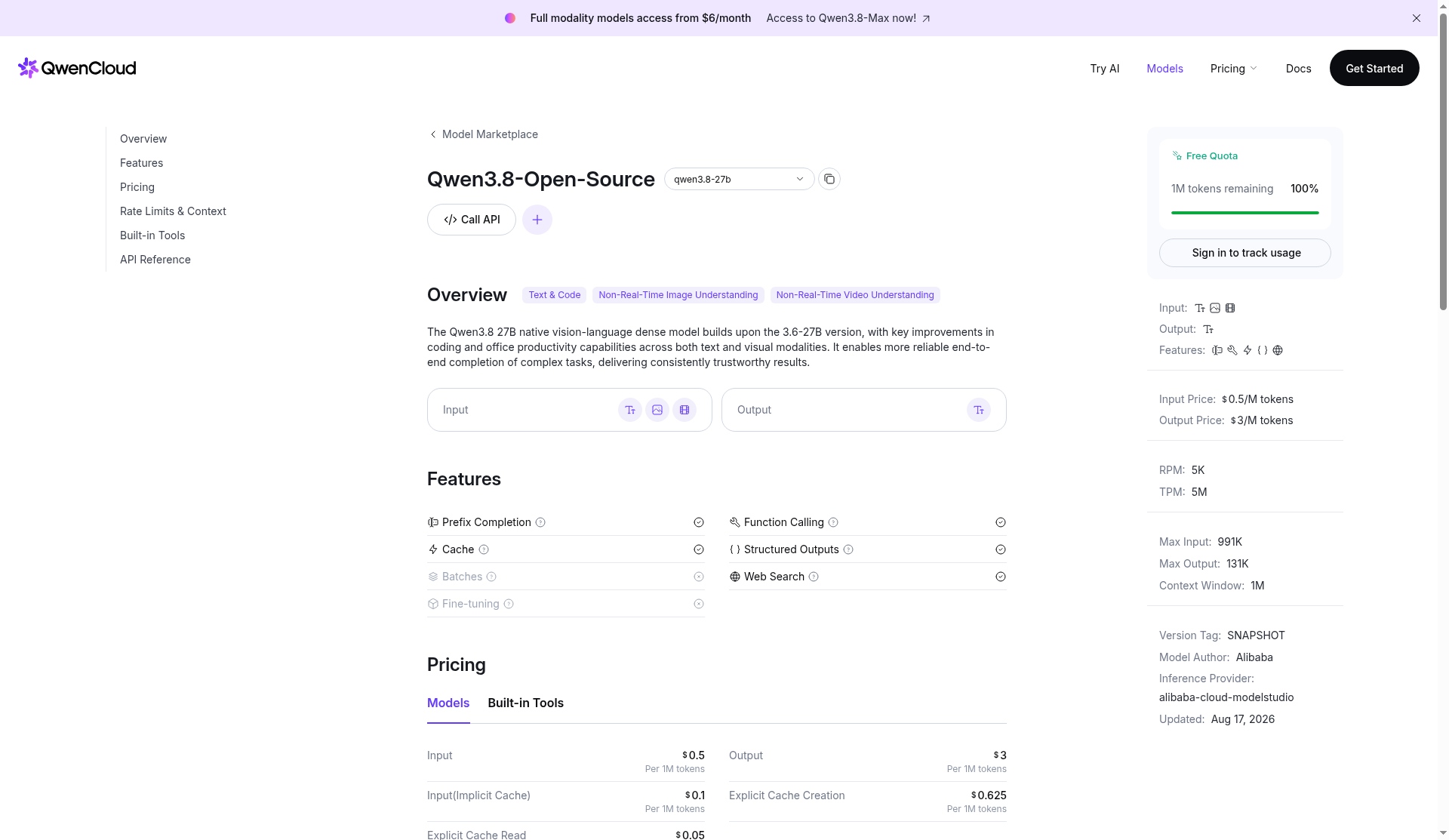
Qwen3.8-27B is Alibaba’s compact open-weight vision-language model in the Qwen3.8 series—a dense 27B causal LM with a vision encoder, aimed at coding, professional work, research, and long-horizon agent tasks. Searches for qwen 3.8 usually want size, context length, multimodal support, and how to run or call it. Per the official Hugging Face model card and QwenLM GitHub news, weights landed on August 14, 2026.
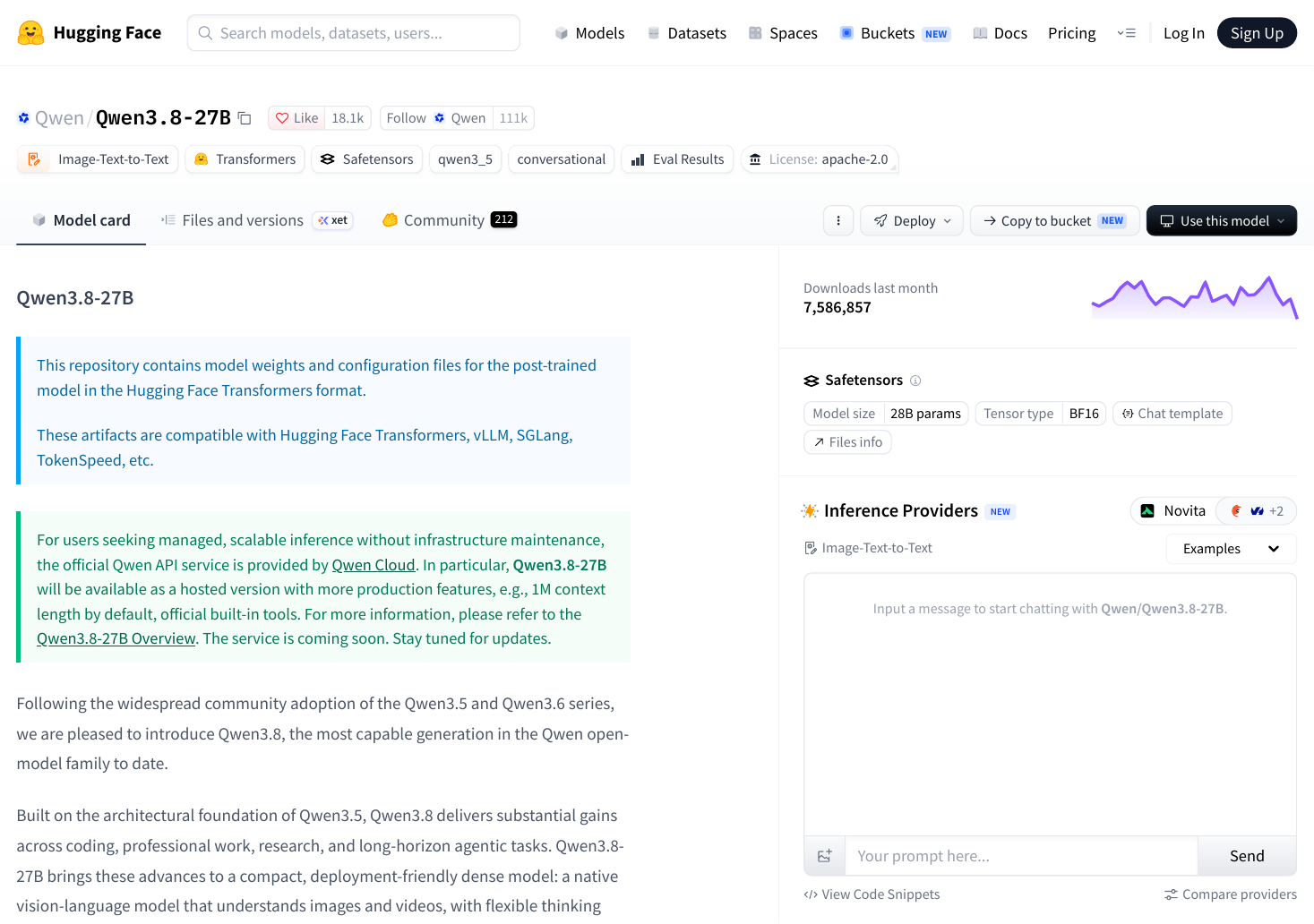
This review summarizes public materials from the Qwen3.8-27B Hugging Face card, the Qwen3.8 GitHub repo, and related Qwen Cloud / Model Studio references. Benchmark numbers below are vendor-reported unless noted.
What Qwen3.8-27B is
Qwen describes Qwen3.8 as the most capable generation in its open-model family to date, built on the Qwen3.5 architectural foundation. The 27B variant is positioned as a deployment-friendly dense model that still carries “Max-class” ambitions into an open release: native image and video understanding, flexible thinking control, and stronger end-to-end agent execution than earlier 27B siblings.
According to the model card, it is a causal language model with a vision encoder, ~27B parameters (listed as 28B params / BF16 on Hugging Face), 64 layers, and a native context of 262,144 tokens, extensible up to 1,000,000 tokens with RoPE scaling (e.g., YaRN) in supported engines.
Key features
- Native vision-language: text, image, and video inputs in one model—STEM diagrams, documents, and longer videos are called out on the card
- Flexible thinking: thinking mode on by default; disable per request; tune depth with
reasoning_effort(xhigh/medium/low); keep historical reasoning viapreserve_thinking - Agent-oriented: stronger planning and environment-feedback handling for multi-step tasks, plus broader harness/tool compatibility
- Serving stack: Transformers, vLLM, SGLang, TokenSpeed recipes; OpenAI-compatible Chat Completions examples on the card
- Hosted path: Qwen Cloud / Qwen Studio for managed inference; card notes a hosted 1M-context version with built-in tools as coming soon
Vendor-reported text highlights include strong coding and agent scores on Terminal Bench 2.1, SWE-bench Pro, CoWorkBench, and related suites; VL highlights include OSWorld-Verified, AndroidWorld, OmniDocBench, and visual math/chart tasks. Treat these as publisher evaluations under the harnesses noted on the card, not independent third-party audits.
How to try or install
Quick try: use Qwen Studio, or Qwen Cloud APIs when your account has access. Qwen also points developers to Qoder, QwenWork, and Qwen Code for productized workflows.
Self-host weights: download Qwen/Qwen3.8-27B from Hugging Face or ModelScope, then serve with a recent vLLM / SGLang / TokenSpeed build. The card recommends thinking-mode sampling (temperature=1.0, top_p=0.95, top_k=20) and separate guidance for instruct/non-thinking mode.
For contexts beyond 262K, follow the published YaRN / rope override snippets for vLLM, SGLang, or TokenSpeed rather than inventing your own scaling factors.
Flexible thinking and multimodal I/O
Out of the box, Qwen3.8-27B thinks before it answers. The model card explains that thinking content is emitted first, then the final reply. You can turn thinking off for latency-sensitive UI work, keep it on for hard coding or agent steps, and dial reasoning_effort among xhigh (default), medium, and low. preserve_thinking retains reasoning blocks across turns so multi-step agents do not re-derive the same plan every message—helpful for KV-cache efficiency as well as consistency.
Multimodal examples on Hugging Face cover math diagrams via image_url payloads and tomb/video questions via video_url. For long video, the card recommends raising the video preprocessor longest_edge when you need denser frame sampling. That makes the 27B weight more than a “text model with an optional captioner”—vision is native to the release.
Where it sits vs other Qwen sizes
Qwen3.8 also shipped a much larger MoE open model (Qwen3.8-2.4T-A95B) days earlier (GitHub news: August 12, 2026 for the MoE, August 14 for the 27B). The 27B dense card is the practical choice when you need one GPU-friendly checkpoint that still tracks Max-class agent and VL goals. Official try surfaces include Qwen Studio, Qoder for agentic coding, QwenWork for office workflows, and Qwen Code in the terminal.
Who it’s for
- Teams that want a single open VLM for coding agents, document/screenshot understanding, and office-style multi-step work
- Builders already on OpenAI-compatible stacks who can point
base_urlat a local or cloud Qwen endpoint - Researchers comparing dense ~30B open models on agent and multimodal suites
Caveats
- Hardware: a full BF16 27B+vision stack is not a laptop toy; plan VRAM/quantization carefully
- Thinking cost: default thinking + preserve_thinking improves agents but burns tokens; lower
reasoning_effortcan speed turns yet may increase retries on hard tasks (per Qwen’s own note) - Hosted features: 1M default context and official built-in tools on Qwen Cloud were described as coming soon on the card—confirm current console status before promising them
- Benchmarks: many scores use specific harnesses and in-house suites; always re-check the footnotes on Hugging Face
Sources
- Hugging Face: Qwen/Qwen3.8-27B model card
- GitHub: QwenLM/Qwen3.8
- Qwen Studio
- Alibaba Cloud Model Studio: qwen3.8-27b docs
Sources verified Oct 20, 2026 (Pacific Time)