OmniRoute is an open-source, local-first AI gateway that exposes one OpenAI-compatible endpoint in front of a large catalog of providers and models—with failover, free-tier aggregation, and coding-agent integrations. People searching omniroute usually want provider count, how the local API works, license, and whether it is free to self-host.
This review is based on the public GitHub repository diegosouzapw/OmniRoute, its README, OpenAPI docs, and the project site. Provider totals and free-token headlines change as the catalog is re-audited—treat live dashboard numbers as authoritative.
What OmniRoute does
Instead of wiring every SDK and free tier by hand, OmniRoute runs as a local proxy/router. Compatible tools (Claude Code, Codex, Cursor, OpenCode, Cline, Copilot integrations, and others listed by the project) can point at a single base URL. Requests are routed across configured providers with strategies for load balancing, fallback, and budget/quota awareness.
- MIT license, free and open source
- OpenAI-compatible local API (docs cite
http://localhost:20128//v1, Bearer key from the dashboard) - Catalog scale in recent README tables: on the order of hundreds of providers and 1,000+ models (e.g. README growth table shows 290 providers at v3.8.49 and higher counts in later tags; GitHub description currently cites ~375 providers / 1,400+ models—verify on the release you install)
- Optional desktop / PWA / Docker / npm distribution paths
- Features called out by maintainers: auto-fallback, free-tier dashboard, compression (RTK + Caveman packs), MCP/A2A surfaces, cost headers, and guardrails
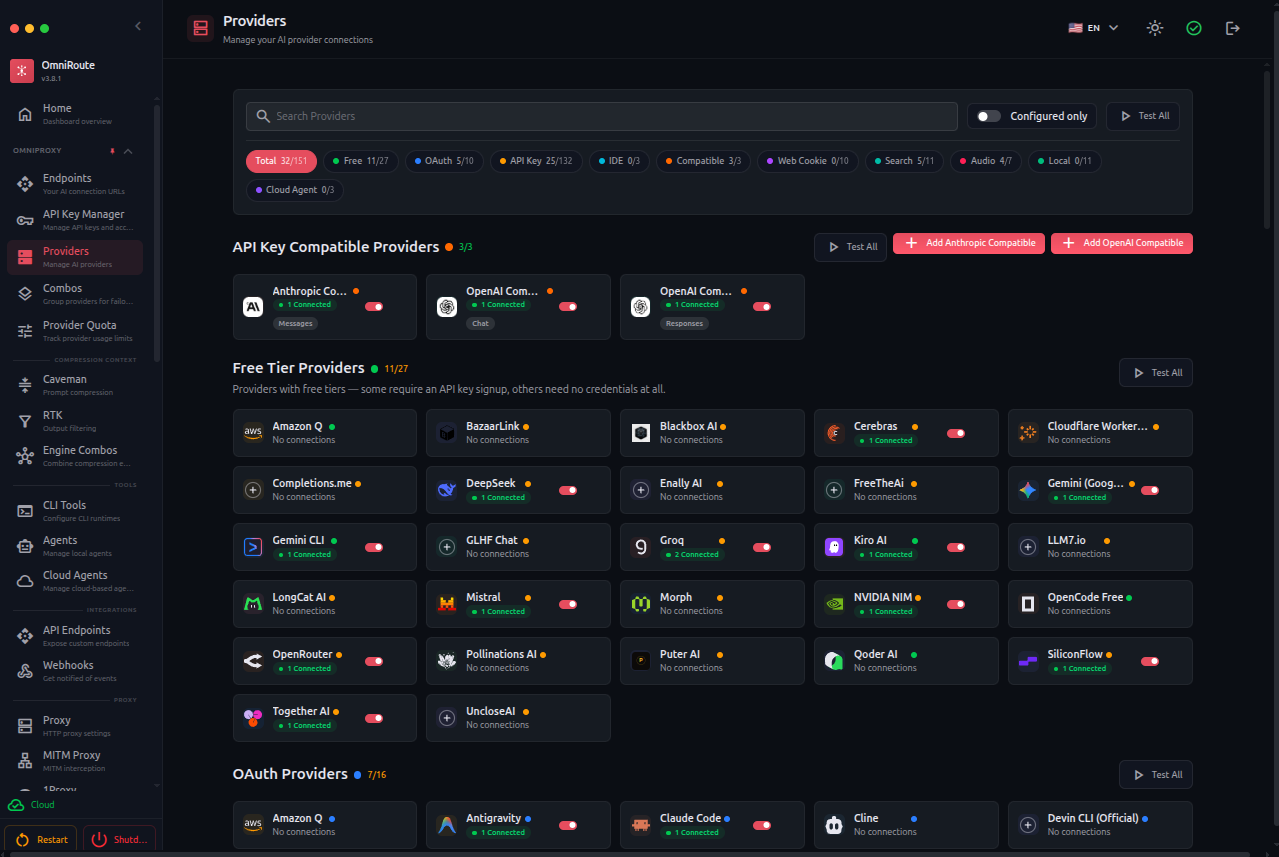
Free tiers and routing (vendor-stated)
OmniRoute’s README markets aggregated free-tier capacity (on the order of ~1.5B+ free tokens/month in recent copy) computed from documented recurring pools, with methodology pages explaining pool deduplication. Those figures are catalog-derived estimates that move when providers change terms—not a guaranteed quota on your account.
Routing highlights from public docs include:
- Multiple routing strategies / “combos,” including task-aware and cache-oriented options
- Quota-Share style sharing of pooled keys (newer releases)
- Response transparency via headers such as
X-OmniRoute-Decisionand cost/usage headers - Media endpoints for image/video/audio generation through supported upstreams
Quick start shape
Exact install commands vary by package (npm, Docker Hub image diegosouzapw/omniroute, Electron builds). The typical flow is:
- Install OmniRoute and open the dashboard
- Enable providers / OAuth / API keys you are allowed to use
- Create a local API key
- Point your coding agent or OpenAI-compatible client at the local base URL
Always follow the README for your installed version—ports, env vars, and CLI helpers (e.g. omniroute launch / setup helpers for popular CLIs) evolve quickly.
Who should try it
- Developers who want one endpoint across many providers with failover
- Teams stacking free tiers who need a dashboard rather than spreadsheet rate limits
- Users of multiple coding agents who prefer a local MIT gateway over a hosted aggregator
Caveats: you are responsible for each upstream provider’s terms, regional identity checks, and key security. Catalog size claims differ slightly across README tables, badges, and GitHub description—pin a release and read its provider reference. Some advanced features (MITM/TPROXY capture, OIDC dashboard gate, optional memory) are powerful but optional and should be enabled deliberately.
Compatible tools and ops notes
The project lists first-class setup helpers for popular coding CLIs and agents. Maintainers also document reverse-proxy basePath support, optional OIDC for the dashboard (password login remains available), prompt-injection and credential-masking guardrails, and remote mode with scoped tokens for VPS-style installs. Compression studios (LLMLingua-2, Ultra, omniglyph, and related packs) are marketed as ways to cut token spend—percent savings in README badges are vendor/demo figures, not a guarantee for every workload.
If you evaluate OmniRoute against hosted gateways, the differentiator is local control: keys stay on your machine (unless you intentionally enable remote mode), and routing decisions are inspectable per response. The tradeoff is operational ownership—you patch OmniRoute, refresh provider catalogs, and monitor upstream outages yourself.
Bottom line
OmniRoute is a mature MIT AI gateway: one local OpenAI-compatible API, a large multi-provider catalog, failover/routing, and first-class coding-agent workflows. Star counts on GitHub are already in the tens of thousands; start from the official repo and verify provider counts on the release notes for the version you run.
Sources
Sources verified Oct 18, 2026 (Pacific Time)