
Jev is TypeSafe AI’s flagship System One model: an API that returns typed, calibrated decisions (not chat text) so software can route, score, and gate workflows without parsing free-form LLM strings. People searching jev ai usually want what System One is, how it differs from chat models, pricing/speed claims, and a first POST /v1/systemone call shape.
Primary sources: TypeSafe’s introducing System One & Jev post (Sep 15, 2026), System One concepts, Models, and the official quick start. (The learnjev.com “first call” URL redirected to a lander when fetched for this article—use the docs quick start instead.)
System One vs chat LLMs
TypeSafe frames System One models after Kahneman’s fast System 1 judgments: unstructured state in, constrained answers out. Relative to typical LLMs (blog comparison table):
- Outputs: type-safe structured values defined up front—not generated strings that must be parsed
- Sampling: parallel answers in one query vs autoregressive token-by-token text
- Training focus: Reinforcement Learning for Calibrated Decisions (RLCD) vs RLHF/RLVR-style chat/verifiable-text objectives
- Hallucinated schemas: TypeSafe states schema matching is guaranteed (0% type-error rate by construction); LLM structured wrappers remain fallible
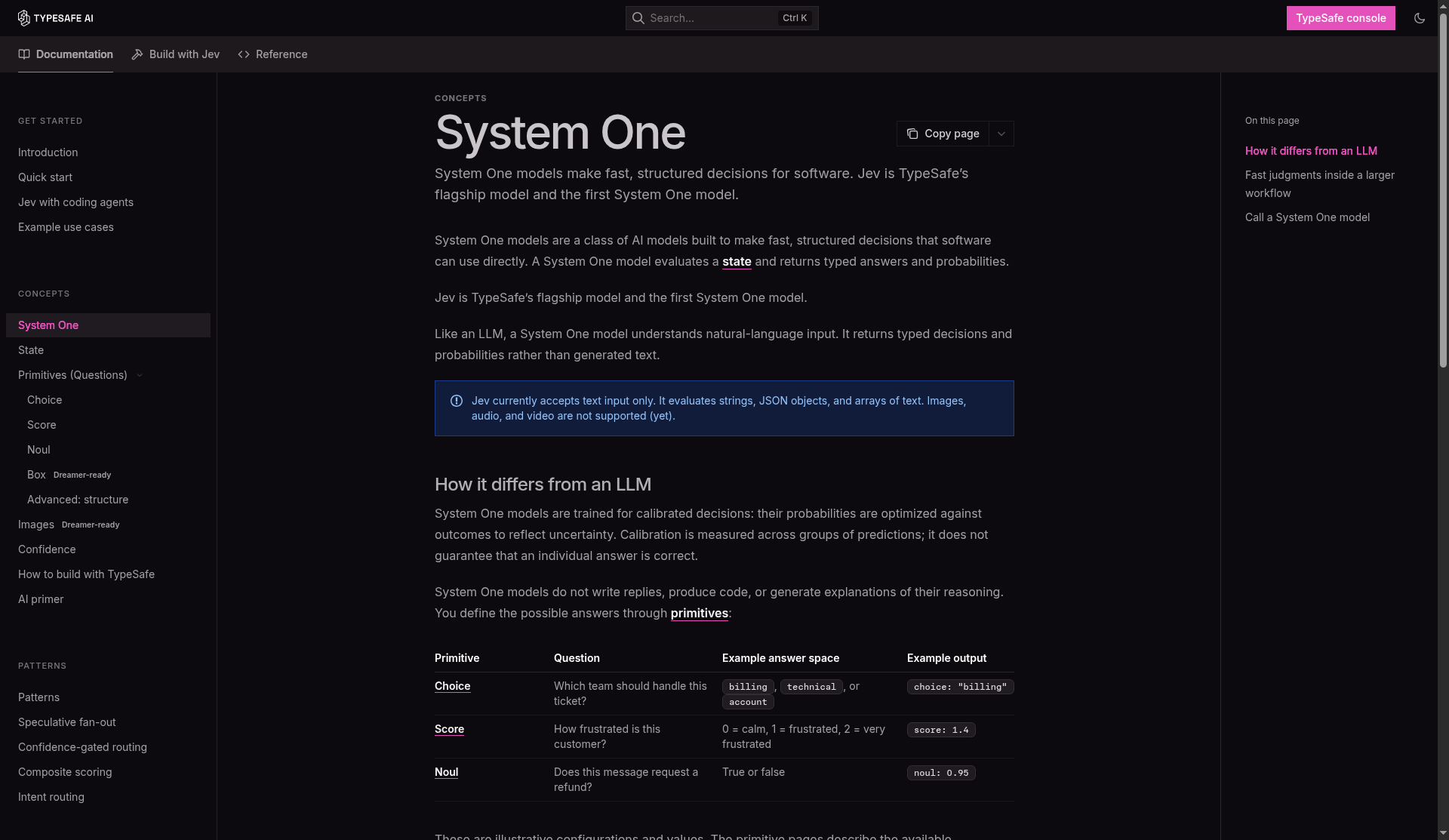
Docs: Jev understands natural-language state but does not write replies, code, or chain-of-thought explanations. You express questions via primitives.
Primitives you call
The quick start and System One concept pages center on:
- Choice — pick one option from a closed set; returns choice + probabilities + confidence
- Score — rate against ordered rubric levels; returns score + probabilities + confidence
- Noul — probability that a yes/no statement is true (0–1)
Typical pattern: put ticket text / JSON records in state, ask several independent questions in one request, then combine answers with deterministic code (confidence thresholds, routing, human escalation).
Models, price, context (docs as of late Oct 2026)
From docs.typesafe.ai/models:
- Jev 1.14 (
jev-1.14.0) — newest release available from October 14, 2026 - Jev 1.13 (
jev-1.13.0) - Price: $42 per billion input tokens / $0.042 per million; output tokens free
- Default context: 64k per-request / 32k per-question; optional long-context header raises both to 262k (slower / less accurate; same $/token)
- Aliases:
jev-latestcurrently points to jev-1.13.0;jev-previewto jev-1.14.0 (aliases move—pin version IDs if you tuned thresholds) - Input: natural-language text as string, JSON object, or text array. Concept docs state images/audio/video are not supported yet on Jev; English is primary for accuracy
Launch-blog latency/cost marketing (Sep 15, 2026) cites end-to-end roughly 70–500 ms, input pricing matching $0.042/MTok, and workflow-eval headlines on the order of ~194× faster / ~445× cheaper vs reference LLM wrappers on TypeSafe’s own harness—those multipliers are vendor evals with stated nuances (West Coast laptop timing, workflow authors on staff, reference models chosen by TypeSafe).
First call shape
Endpoint: POST https://api.typesafe.ai/v1/systemone with Bearer API key. SDKs: Python typesafe-sdk, JS/TS @typesafe-ai/sdk. Minimal idea from the quick start: one state string (e.g., a support ticket) plus questions for department (Choice), frustration (Score), and urgency (Noul). Responses include per-answer probabilities/confidence so code can auto-act or escalate.
Build patterns TypeSafe documents
Docs cookbooks and patterns show where Jev fits beside LLMs rather than replacing them: confidence-gated routing, speculative fan-out of many questions in one call, composite scoring in code, LLM I/O guardrails, citation checks, RAG passage scoring, and hierarchical classification. Parallel-questions cookbook claims batching many questions into one System One call can be on the order of ~10× faster and ~12× cheaper than separate calls with unchanged answers—again a TypeSafe-measured example, useful as a design hint.
Data handling: TypeSafe states Jev is not trained on customer requests/responses; enterprise zero-data-retention options are pointed from the Legal docs. Customize behavior through richer state and question instructions—not per-tenant fine-tunes or LoRAs.
Who should try Jev
- Product/backends needing smart if-statements: classify, route, score, extract, guardrail LLM I/O
- Latency-sensitive paths where multi-second chat completions are a bottleneck
- Map-reduce style feature extraction over large text corpora
Caveats: Early access / org rate limits apply. Jev is not fine-tuned per customer—you encode domain rules in state + question instructions. It is a poor substitute when you need prose, code generation, or open-ended tool babble; pair it with LLMs when generation is required and use Jev for the decision layer.
Bottom line
Jev is TypeSafe’s System One decision model: structured probabilistic answers for software, parallel multi-question calls, transparent input-token pricing with free outputs, and a deliberate non-chat interface. Start from the official quick start and pin jev-1.13.0 / jev-1.14.0 rather than chasing secondary tutorial mirrors.
Sources
- TypeSafe blog: Introducing System One Models & Jev
- TypeSafe docs: System One
- TypeSafe docs: Models
- TypeSafe docs: Quick start
- learnjev.com first-call tutorial (redirected when verified; prefer docs quick start)
Sources verified Oct 19, 2026 (Pacific Time)