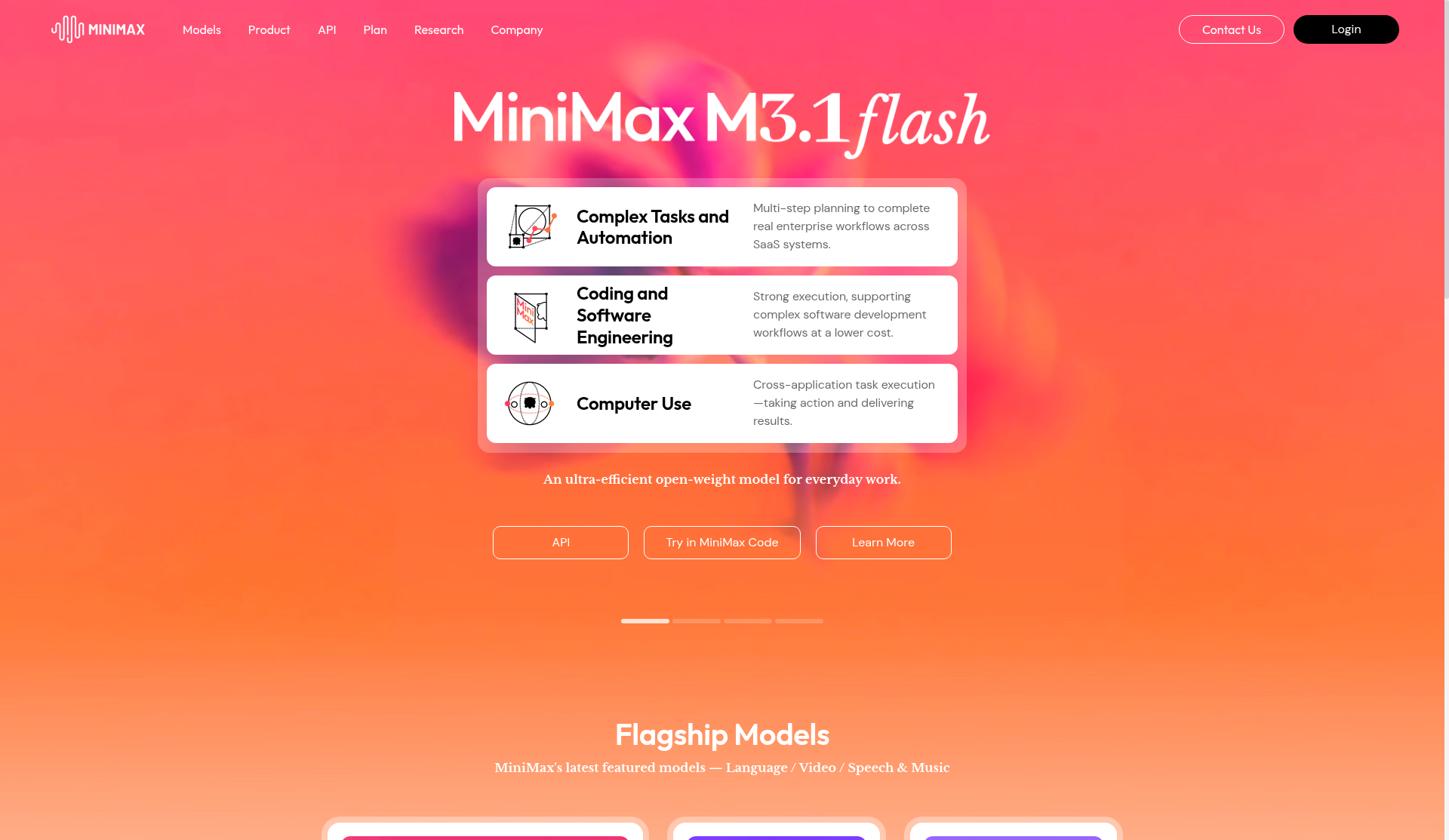
MiniMax M3.1 Flash (API id MiniMax-M3.1-Flash) is MiniMax’s October 19, 2026 Flash-tier multimodal model for agent workflows, coding, and long-context work. Searches for minimax 3.1 flash usually want release date, context window, pricing, and how to call the API. The company says it is nearly 3× faster online and about 70% cheaper for agentic usage than its predecessor, with open weights planned for later.
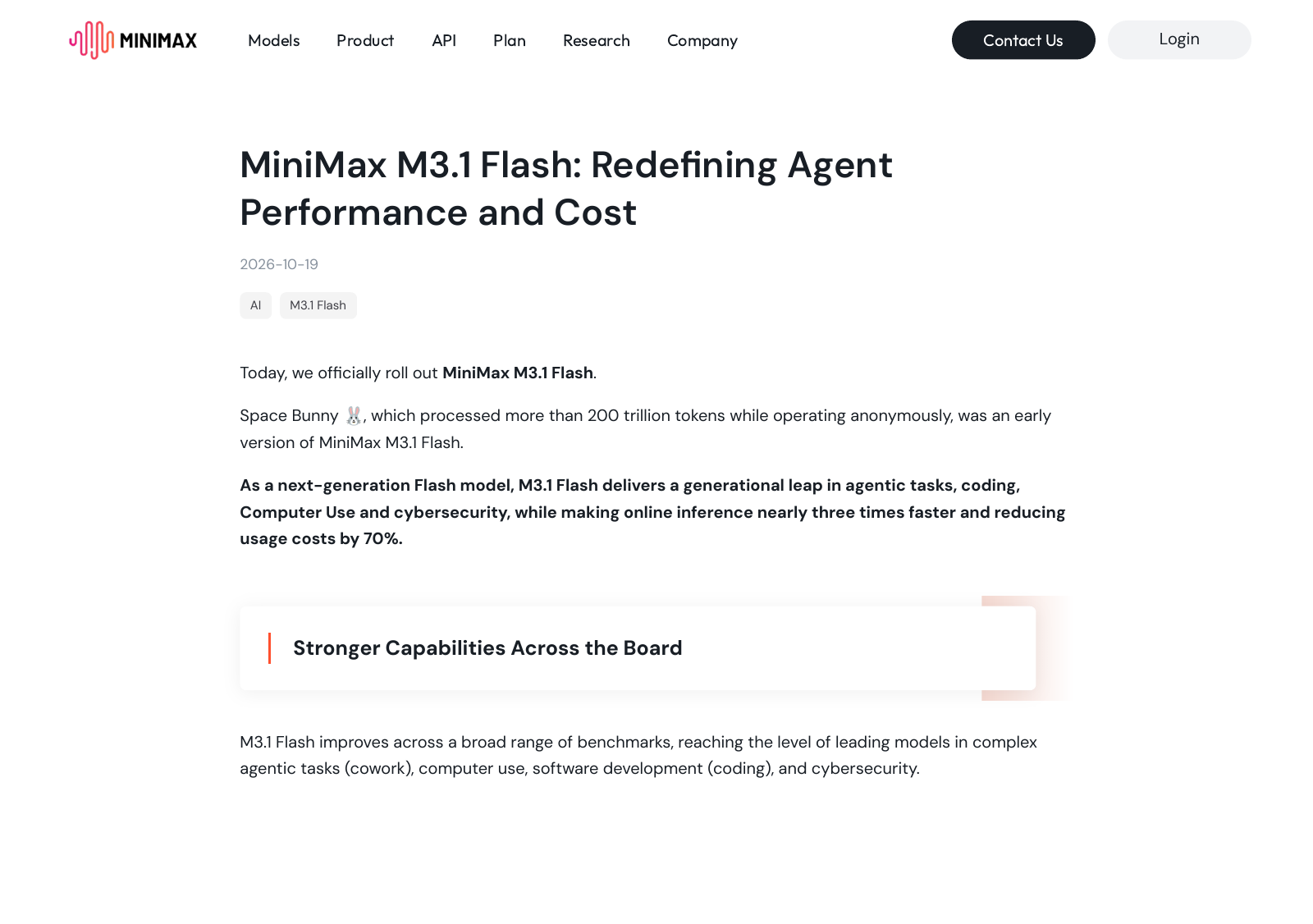
This review draws on the official MiniMax M3.1 Flash blog, platform text-generation docs, and third-party listings such as OpenRouter. Capability and cost figures are vendor-stated unless noted.
What MiniMax M3.1 Flash is
MiniMax positions M3.1 Flash as a next-generation Flash model focused on complex agentic tasks (“cowork”), computer use, software engineering, and related automation—while keeping inference speed and price aggressive. The blog notes that the anonymous “Space Bunny” system that processed more than 200 trillion tokens was an early version of this model.
Platform docs list a 1,000,000-token context window, multimodal chat input (text, image, and video), and tunable thinking depth via an effort control. Anthropic-compatible and OpenAI-compatible endpoints are both supported.
Key features
- 1M context for long documents, large repos, and multi-step agent sessions
- Tunable effort: docs accept
low,medium,high,xhigh, andmax(defaultmaxwhen omitted) - Agent & coding focus: blog cites AutomationBench-AA, BankerToolBench (76.2), DeepSWE v1.1 (73.7%), OSWorld V2 (61.7), Agents’ Last Exam (29.6), and CyberGym (82%) as vendor results
- Speed: everyday output speeds claimed at 200+ TPS, with median (P50) consistently 170+ TPS
- Flat API pricing (blog): $0.15 input / $0.60 output / $0.015 cached input per 1M tokens
- Product surfaces: MiniMax API, M Plan, and MiniMax Code (agent.minimax.io/download)
OpenRouter listed a temporary free route around launch (free period described as ending Thursday, Oct 22, 2026 at 12:00 UTC on that page); after that, expect list pricing on the base slug. Always re-check the live pricing page before budgeting.
How to try
Create a key on platform.minimax.io. Docs recommend the Anthropic-compatible base URL https://api.minimax.io/anthropic for thinking blocks and advanced features, or the OpenAI-compatible base https://api.minimax.io/v1. Set model to MiniMax-M3.1-Flash and choose an effort level for the task.
For a desktop coding agent experience, MiniMax points users to MiniMax Code downloads. Model weights are not open at launch—the blog says they will be released later—so self-hosting the weights is not an option yet.
API shape and thinking controls
MiniMax documents both Anthropic-compatible and OpenAI-compatible calling styles. The Anthropic-compatible base (https://api.minimax.io/anthropic) is recommended when you want thinking blocks and interleaved thinking. On the OpenAI-compatible path, the chat-completions style remains familiar to existing SDK users. In either case the model name is MiniMax-M3.1-Flash.
Effort (thinking depth) is first-class: omit it and the platform defaults to max. That is great for hard agent traces, but everyday summarization or simple transforms usually do not need maximum deliberation—set low or medium to protect latency budgets. Docs also describe prompt caching with a separate cached-input price, which matters when agent loops resend large system prompts or repo digests.
Cost and speed positioning
The launch blog frames Flash as a generational efficiency play: more aggressive sparsity, online inference nearly three times faster, and agentic usage cost about 70% lower than the prior generation, with published list prices of $0.15 / $0.60 / $0.015 per million tokens (input / output / cached input). Throughput claims of 200+ TPS peak and 170+ TPS median (P50) are vendor measurements—validate on your workload and region.
Availability spans the MiniMax API, M Plan, and MiniMax Code. OpenRouter mirrored the model around launch with a short free window that the listing said would end October 22, 2026 at 12:00 UTC; after that, plan on list pricing via the base model slug.
Who it’s for
- Product and ops teams automating multi-step SaaS / office workflows where token cost dominates
- Developers who want a fast multimodal coding model behind OpenAI- or Anthropic-style SDKs
- Builders evaluating computer-use and long-horizon agent benchmarks at Flash pricing
Caveats
- Closed weights for now: API-only until the promised open release
- Vendor benchmarks: scores and “ranks first among Chinese models” claims come from MiniMax’s post; independent replication may differ
- Security-related scores: CyberGym and internal security evaluations are capability marketing—use only in authorized defensive contexts and follow applicable law and policy
- Default max effort: thorough reasoning improves hard tasks but raises latency and cost; dial effort down for simple calls
Sources
- MiniMax blog: MiniMax M3.1 Flash (2026-10-19)
- MiniMax docs: Text model invocation
- MiniMax Code download
- OpenRouter: MiniMax M3.1 Flash listing
Sources verified Oct 20, 2026 (Pacific Time)