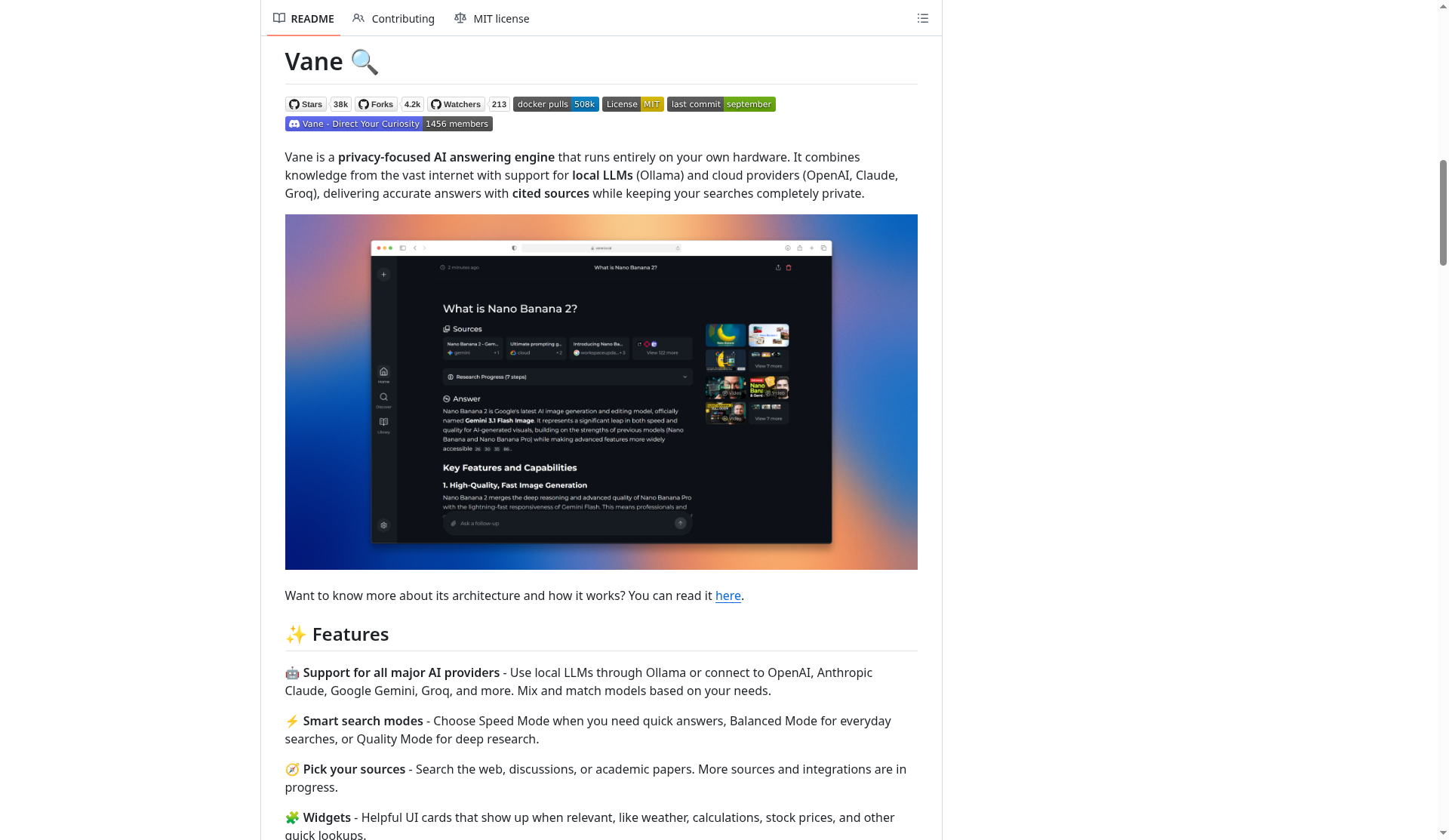
Vane is a privacy-focused, self-hosted AI answering engine—an open-source alternative to cloud “answer engines” in the Perplexity style. Searches for a vane open source perplexity alternative usually want install steps, LLM options, and how it differs from hosted search chat. The project is MIT-licensed at ItzCrazyKns/Vane; the former GitHub path ItzCrazyKns/Perplexica now redirects to Vane.
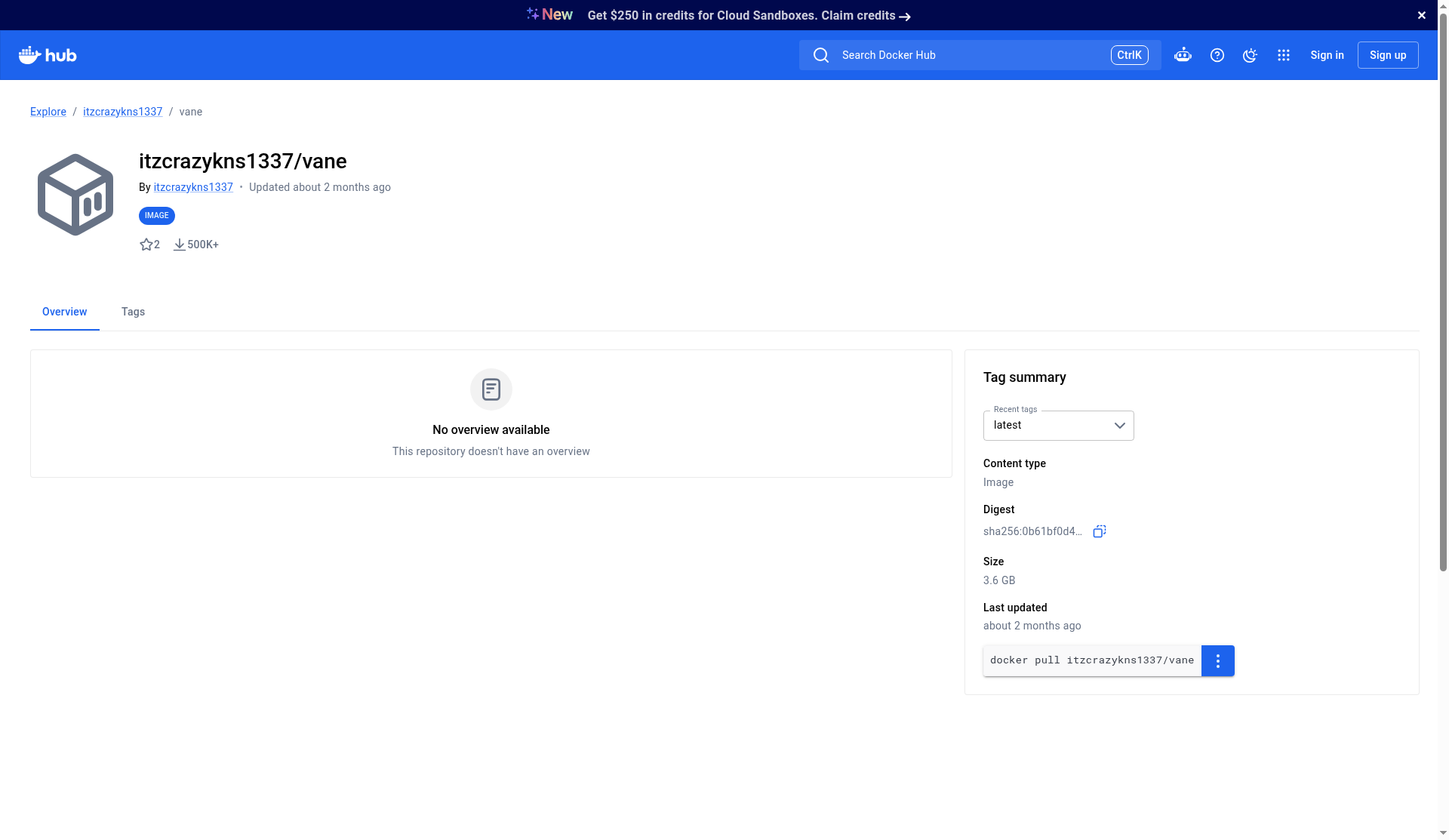
This review is based on the project README, Docker Hub image itzcrazykns1337/vane, and the live GitHub repository metadata. Feature lists below match what the maintainers document publicly.
What Vane is
Vane combines web search (via bunded SearxNG by default) with your choice of local or cloud LLMs to produce answers with cited sources, while keeping search traffic and history under your control. It is designed to run on your own hardware rather than sending every query to a single commercial answer API.
Community discussion and the repo rename confirm the project previously shipped under the Perplexica name; documentation and Docker tags now use Vane. As of this writing the public GitHub repo reports tens of thousands of stars, and Docker Hub shows substantial pull volume for itzcrazykns1337/vane.
Key features
- Bring your own models: local LLMs through Ollama, plus cloud providers such as OpenAI, Anthropic Claude, Google Gemini, Groq, and other OpenAI-compatible endpoints
- Search modes: Speed, Balanced, and Quality for quick answers vs deeper research
- Source control: web, discussions, and academic-oriented search; domain-limited search for docs-heavy queries
- Media & files: image/video search widgets; upload PDFs, text, and images to ask questions about your documents
- UX extras: widgets (weather, calculations, stocks, etc.), smart suggestions, Discover browsing, and local search history
- Privacy-minded stack: SearxNG-backed search; data volume persistence under Docker
How to install
Docker is the recommended path. From the README:
docker run -d -p 3000:3000 -v vane-data:/home/vane/data --name vane itzcrazykns1337/vane:latest
Then open http://localhost:3000 and finish setup (API keys, models, etc.) in the onboarding screen. The default image bundles SearxNG. If you already run SearxNG, use the slim image and set SEARXNG_API_URL; JSON format and Wolfram Alpha must be enabled on that SearxNG instance per the docs.
Non-Docker installs clone the repo, run npm i, npm run build, and npm run start after configuring SearxNG yourself. For Ollama inside Docker on Linux, expose Ollama on the host network and point Vane at the host’s private IP (Windows/Mac often use host.docker.internal).
Architecture in plain terms
Vane is not a single closed model. It is an answering front-end that orchestrates (1) a metasearch backend—SearxNG in the default Docker image—(2) an LLM of your choosing, and (3) a UI that presents citations, modes, and optional widgets. The architecture docs in the repo walk through how those pieces talk to each other if you need to customize deployment topology.
Because search stays on infrastructure you control, query logs and uploaded files land in your volumes instead of a third-party answer SaaS. That is the core privacy pitch versus hosted Perplexity-like products: you still need internet search, but you decide which engines SearxNG fans out to and which model writes the final answer.
Day-two operations
Plan for updates (pull a newer itzcrazykns1337/vane:latest), persistent vane-data backups, and correct Ollama/Lemonade URLs when the UI runs inside Docker while models run on the host. The README’s troubleshooting section covers empty API-key fields on local OpenAI-compatible servers and Linux systemd tweaks to expose Ollama on 0.0.0.0. If answers feel thin, switch from Speed to Quality mode or upgrade the underlying LLM before blaming the UI.
Sponsors listed on the README (such as Exa) hint at a roadmap toward richer search APIs beyond SearxNG; treat “coming soon” items as optional until they land in a release you pin.
Who it’s for
- Individuals and teams who want cited web answers without depending solely on a hosted Perplexity-like service
- Homelab and privacy-conscious users pairing SearxNG with local Ollama models
- Researchers who need domain-scoped search and document Q&A on their own disk
Practical expectations vs hosted answer engines
Hosted Perplexity-style products optimize for zero-setup polish: accounts, ranking, and model routing are someone else’s problem. Vane trades that convenience for ownership. You will spend time choosing models, confirming SearxNG returns useful results in your region, and teaching teammates where history lives. In return you get MIT-licensed code, local file uploads, and the ability to keep sensitive research queries off a single commercial answer silo.
For many indie researchers and IT teams, that trade is the point of looking for a vane open source perplexity alternative in the first place. Start with Docker, one cloud key or a local Ollama model, and a few Quality-mode queries on domains you know well before rolling it out more widely.
Caveats
- You operate the stack: Docker, keys, model quality, and SearxNG health are your responsibility
- Answer quality varies with the LLM and search backends you configure—Vane is the harness, not a single frontier model
- Rename lag: older blog posts and forks may still say Perplexica; prefer the Vane repo and
itzcrazykns1337/vaneimages - Not a drop-in SaaS: no built-in hosted SLA; plan backups for the
vane-datavolume
Sources
- GitHub: ItzCrazyKns/Vane
- Vane architecture docs
- Docker Hub: itzcrazykns1337/vane
- GitHub Discussion: Vane rename / Perplexica naming
Sources verified Oct 20, 2026 (Pacific Time)