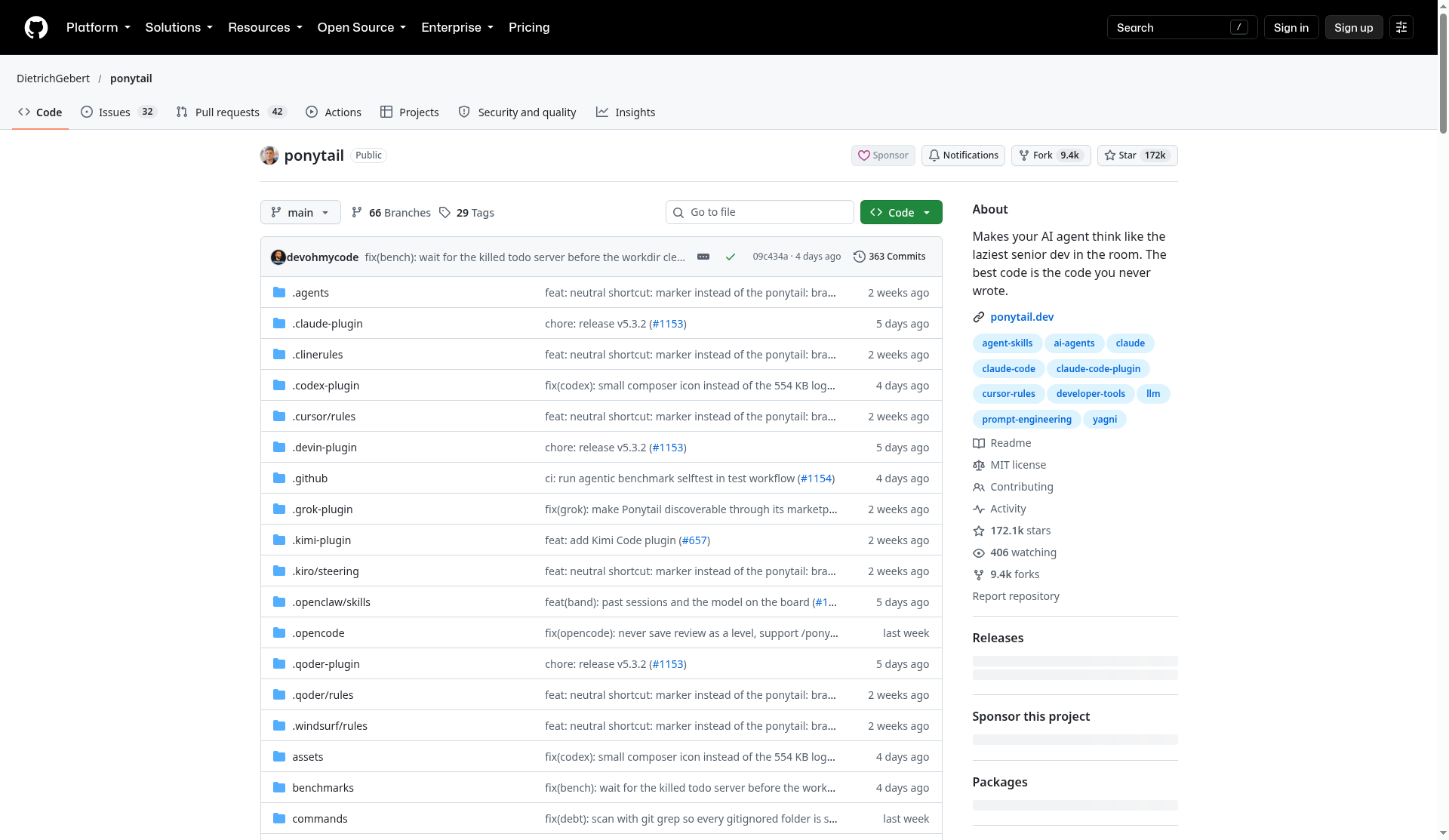
Ponytail is an open-source AI coding skill on GitHub (DietrichGebert/ponytail) that makes an agent behave like a “lazy senior developer”: solve the whole task with the least new code, reuse what already exists, and never cut validation, security, or accessibility. Searches for ponytail github usually want install steps for Claude Code or Codex, the lite/full/ultra levels, and what the project claims in its Ponytail 5 benchmarks.
This review summarizes the public README and the skill prompt at skills/ponytail/SKILL.md. Benchmark figures below are project-reported, not independent third-party audits. Do not invent popularity metrics—check the live GitHub page for current stars and activity.
What Ponytail is
The README’s pitch: “The best code is the code you never wrote.” Ponytail is one prompt (plus adapters) that loads into coding agents. After it reads the code a change touches, it walks a ladder: skip unneeded features → reuse in-repo helpers → prefer stdlib/platform features → use already-installed dependencies → write the minimum that works.
The skill file states the standing rule clearly: be lazy about the solution, never about finishing the change—including callers, tests, and fixtures the edit breaks. Non-trivial new logic should leave a small test. Deliberate shortcuts get a shortcut: comment for later debt tracking.
Modes: lite, full, ultra
- lite — Build what was asked; name a smaller option in one line and let the user choose
- full — Default; full lazy-senior ruleset
- ultra — Also push back on parts of the request that the need does not justify
- off — Disable until you turn it back on
Switch with /ponytail lite|full|ultra|off (hosts that support the commands).
Install (from the official README)
Claude Code (two plugin commands):
/plugin marketplace add DietrichGebert/ponytail
/plugin install ponytail@ponytail
Codex:
codex plugin marketplace add DietrichGebert/ponytail
codex plugin add ponytail@ponytail
Then open /hooks in Codex, trust the two lifecycle hooks, and start a new thread.
Other agents: copy AGENTS.md into the project or install skills/ponytail/SKILL.md as a skill. The repo’s INSTALL.md covers Copilot, Cursor, OpenCode, Gemini, and related hosts.
The README warns: only install from DietrichGebert/ponytail on GitHub or @dietrichgebert/ponytail on npm. It does not ship .exe / .dll files; a copy that does is not official.
Commands worth knowing
/ponytail— report or set level/ponytail-review— review the current change for bugs, security, load, missing tests, and what to cut/ponytail-audit— same style of check across the whole repo, prioritized/ponytail-debt— harvest deferredshortcut:comments/ponytail-gain— show the project’s measured impact scoreboard from its benchmark/ponytail band— Claude Code UI band for cost/tokens/reuse (needs Claude Code 2.1.290+; not in VS Code chat / cloud /claude -p)
Command availability depends on the host; instruction-only adapters may load the always-on rules without slash commands.
Ponytail 5 benchmarks (vendor / project-reported)
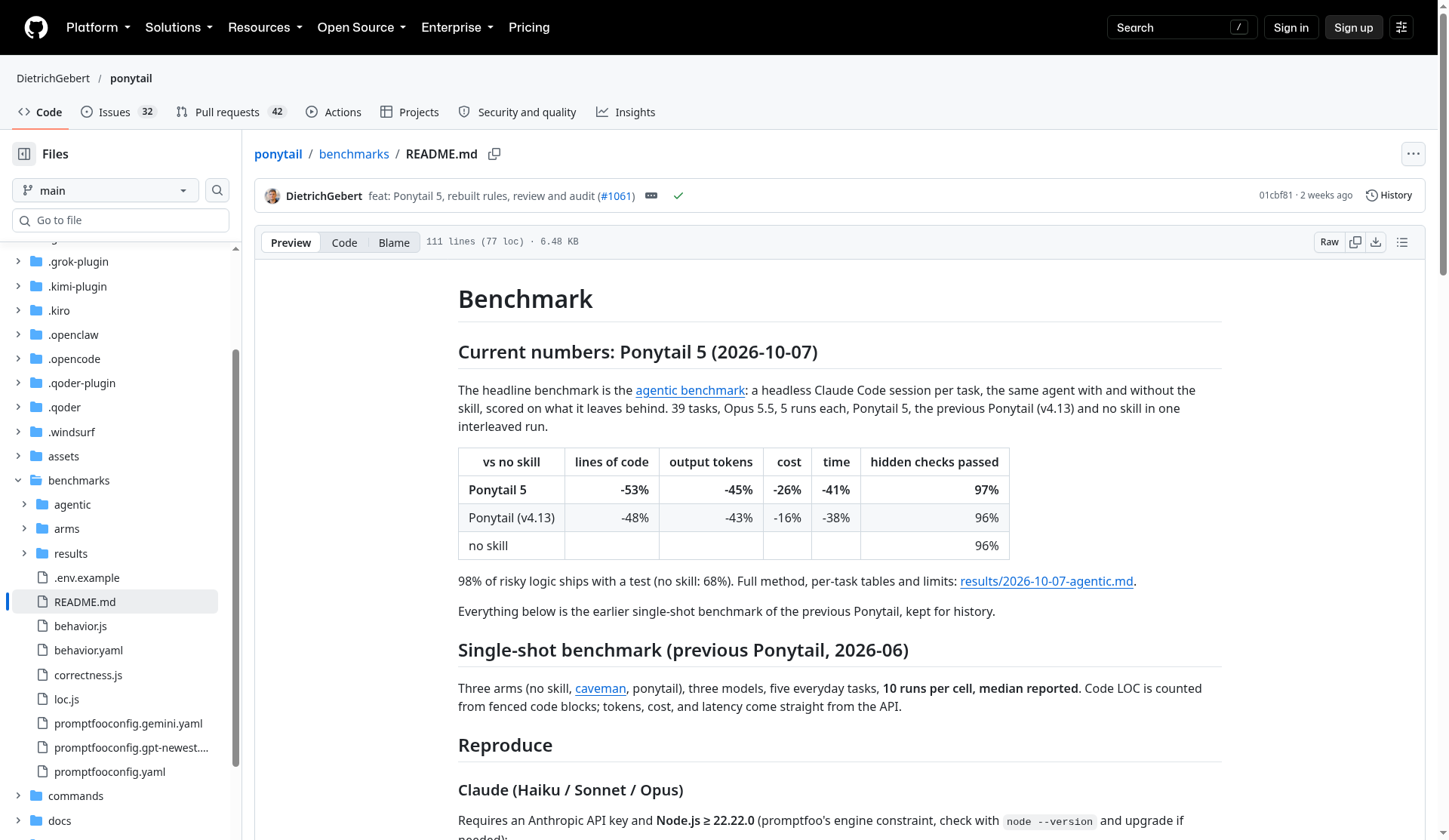
The README headlines Ponytail 5 results from the maintainers’ own agentic benchmark (same agent with and without the skill; Claude Code; Opus 5.5; 39 tasks including a real FastAPI + React repo; 5 runs each). Project-reported deltas include roughly 53% less code, 41% less time, 26% less cost, and 45% fewer tokens, with risky logic shipping with a test in 98% of cases vs 68% without Ponytail.
They also report a blind comparison where Ponytail 5 replies beat the previous Ponytail 110 to 67, and that six security-oriented tasks passed all 30 runs. Method and per-task tables live in the repo under benchmarks/results/2026-10-07-agentic.md. Treat every figure as publisher evaluation under their harness—not an external audit.
The README’s own caveat: the rule was never “fewest tokens.” It is write only what the task needs, without cutting validation, error handling, security, or accessibility. Smaller diffs and lower cost are side effects.
Who it is for
- Developers tired of agents that invent frameworks for one-line jobs
- Teams on Claude Code or Codex who want a persistent “YAGNI” bias
- Reviewers who want structured
/ponytail-reviewand/ponytail-auditpasses
Caveats
- Host differences: not every IDE gets the full command set or the Claude Code “band”
- Ultra mode friction: pushback is intentional; disable or drop to lite when you need speed over debate
- Benchmarks: project-run on specific models/tasks; your repo and model will differ
- Trust the source: install only from the official GitHub/npm identifiers named in the README
Sources
- GitHub: DietrichGebert/ponytail
- Ponytail README (raw)
- Ponytail SKILL.md
- Project benchmark write-up (2026-10-07)
Sources verified Oct 21, 2026 (Pacific Time)