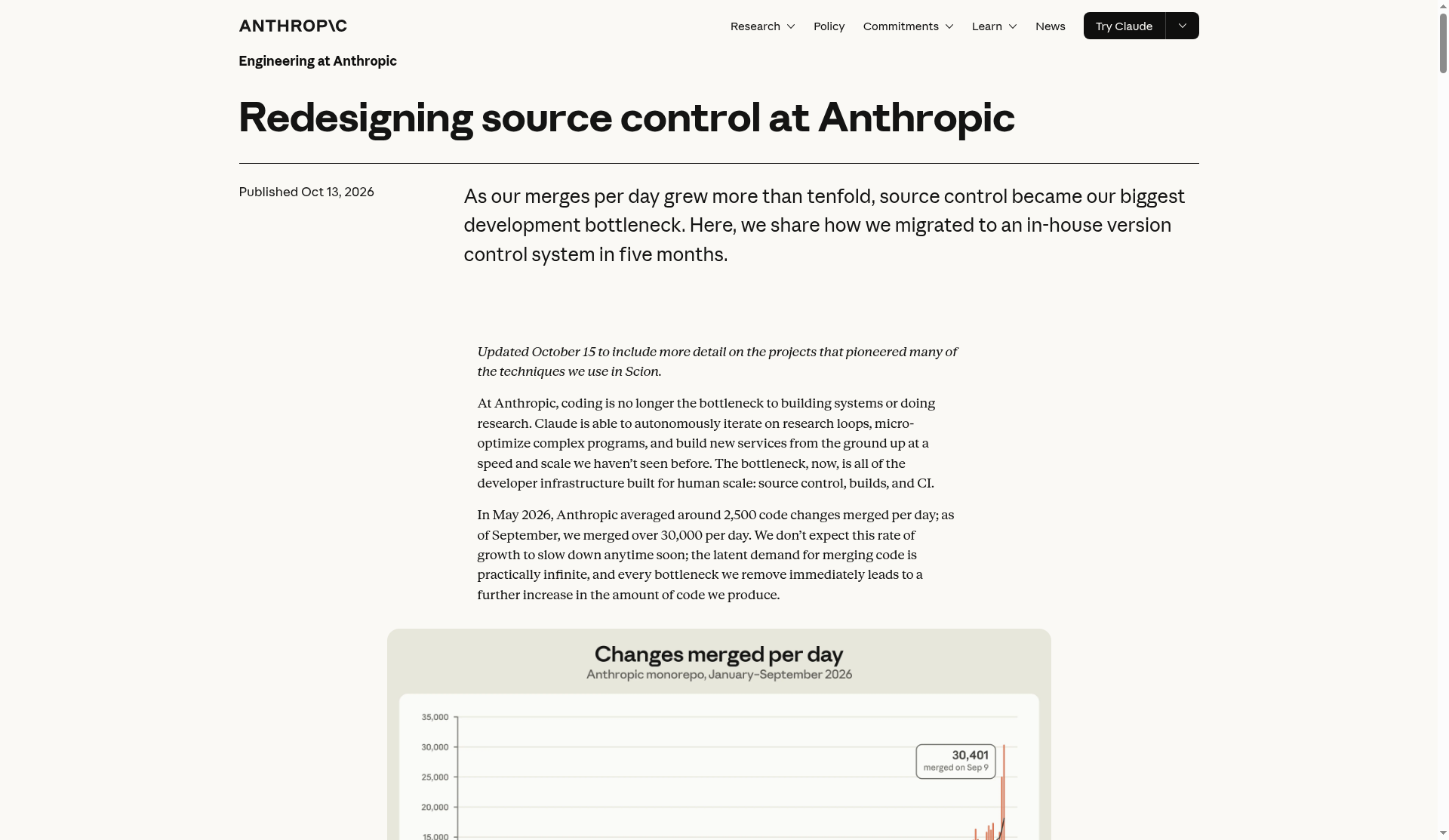
Anthropic Scion (also searched as scion anthropic) is Anthropic’s in-house version control system. In an October 13, 2026 engineering post, the company explained that it fully migrated its monorepo from git to Scion in about five months after daily merges grew more than tenfold. Searches for anthropic scion usually want a plain answer: what it is, why git stopped scaling for Anthropic, and whether outsiders can use it (they cannot—Scion is internal).
What Anthropic Scion is
Scion is a centralized, server-centric source control stack built for agent-scale monorepos. Alongside Scion, Anthropic shipped related internal tools in the same period, including a code review surface called Antique, code search, and a rich source-control IAM system. The company frames Scion as a response to developer infrastructure—not model coding—becoming the bottleneck once Claude could iterate research loops and services at high volume.
Why Anthropic left git
Anthropic’s engineering post states that in May 2026 the company averaged around 2,500 code changes merged per day; by September 2026 it merged over 30,000 per day. The main-branch history alone was almost 100 GB, with a compressed working copy over 25 GB. CI alone performed on the order of 25 million code checkouts per day (before developer environments, agent sandboxes, and research jobs). Fetched naively, Anthropic estimated that would imply over 600 PB of git traffic per day.
Git’s strengths—decentralized clones that work offline—clashed with a workload where nearly all clients (agents and jobs) are online by definition. Anthropic had already used shallow clones, sparse checkouts, promisor remotes, internal mirrors, and repository “seeds” in blob storage. At peak it operated several hundred internal git mirrors. Those workarounds bought time but became harder to operate as merge rate and repo size grew.
Design principles (from Anthropic)
- Clients are always online — fetch what you need from a reachable server instead of assuming a full offline clone
- Client–server asymmetry — the server does history, blame, commits, merges, and rebases; the client keeps a bounded cache and working copy
- API-first source control — the same queries the client uses are exposed via API, so many jobs need no local repo
- Horizontal scalability — repository data is distributed; Anthropic states there is no fully materialized copy of the repo anywhere, even on the server, and no git-style packfile maintenance
- Cheap, incremental, lock-free commits — commits, rebases, and merges happen on the server; there is nothing to push in the git sense
- Optional / sparse working copies — CI can ask the server for diffs and related metadata; sparse and virtualized checkouts materialize only what is read
Anthropic cites prior art such as Google’s Piper and Meta’s Sapling (especially Sapling’s Mononoke / Bonsai data model) as inspiration for techniques used in Scion.
How Scion stores changes
The unit of work is a changeset in a write-ahead log. Unlike a git commit that points at a full tree, a Scion changeset stores the files changed relative to its first parent, plus content-addressed pointers to compressed file contents in blob storage. Changesets are created server-side and become available everywhere immediately. Additional “derived data” (blame, path history, commit-graph skip lists, and similar indexes) is computed from changesets so history queries stay fast without shipping full packs to every client.
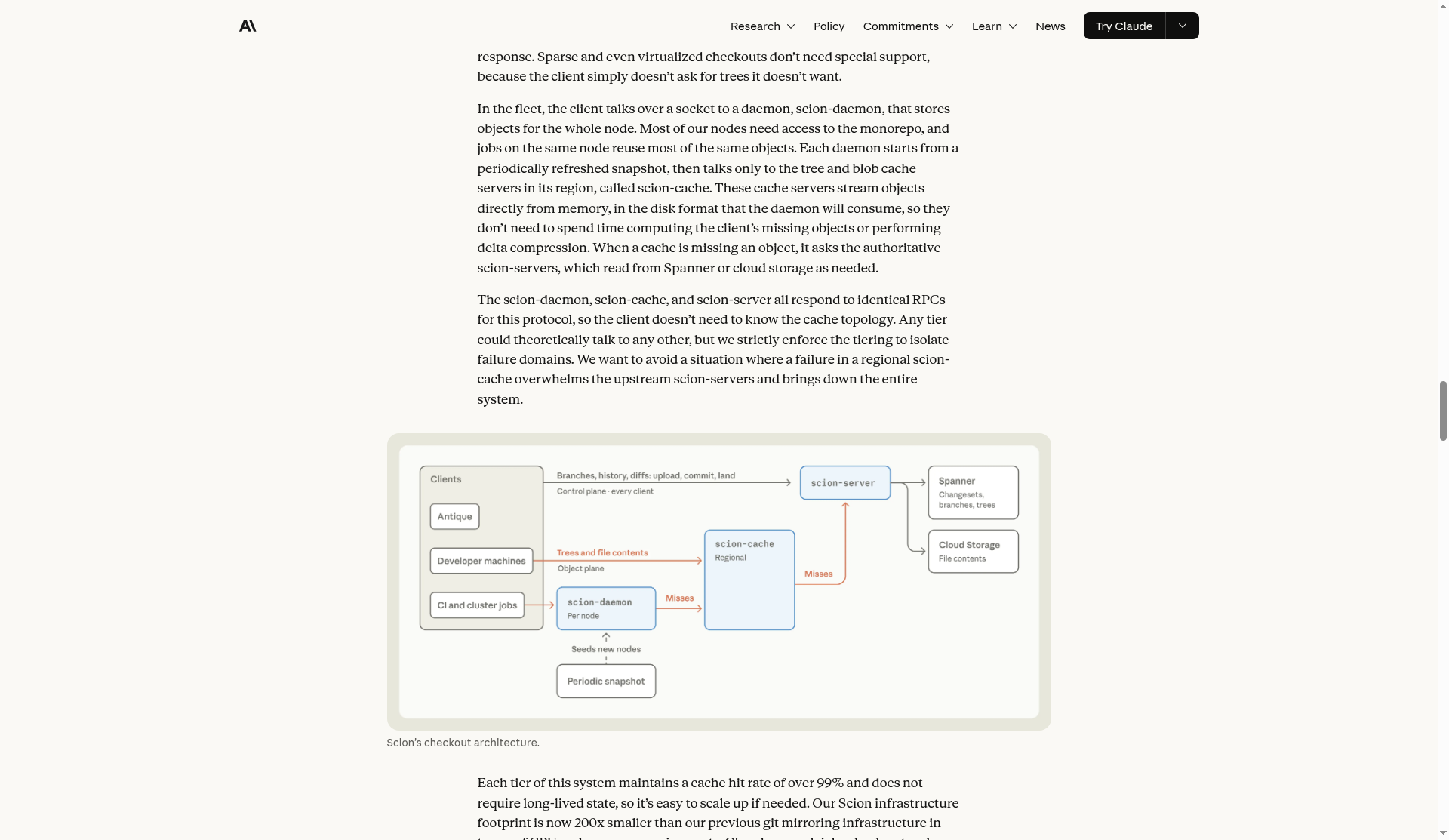
Checkout traffic is tiered: a node-local scion-daemon, regional scion-cache servers, and authoritative scion-server backends reading Spanner or cloud storage. Anthropic reports each tier maintains a cache hit rate over 99%, a Scion infrastructure footprint about 200× smaller (CPU/memory) than prior git mirroring, CI/research checkouts two orders of magnitude faster (seconds rather than minutes), and about a 25% CI CPU capacity win.
Team size and timeline
A team of seven people built Scion and Antique (plus related systems) and completed the monorepo migration in five months, while daily merges rose roughly 10×. Anthropic also describes using Claude extensively to rewrite subsystems (for example, an early git-to-Scion ingestion pipeline that Claude Mythos Preview reportedly made much more memory- and speed-efficient) and operating “superfan” Claude monitors on individual components.
Is Scion publicly available?
No. Anthropic states Scion is by no means a suitable replacement for git for general use. It diverges enough that adopters would need to migrate code review, search, and CI; Anthropic’s internal versions of those pieces are bespoke. The company also notes that its internal token budget for building such systems exceeds what most organizations would spend. Anthropic says it is sharing the design so others can apply ideas to git (stronger server-side RPCs, better sparse/shallow composition) and wants to partner with GitHub, GitLab, and the open-source community—not ship Scion as a public product. Independent coverage (The New Stack) likewise summarizes: Scion is internal; outsiders get inspiration, not a download.
Bottom line
For the query anthropic scion: Scion is Anthropic’s private VCS that replaced git after merges crossed ~30k/day, with sparse online clients, server-side commits, and a much smaller infra footprint than hundreds of git mirrors. It is not available outside Anthropic. If you are scaling agent-heavy monorepos on git, treat Anthropic’s post as architecture notes—not a product announcement.
Sources
- Anthropic Engineering: Redesigning source control at Anthropic
- The New Stack: Anthropic built its own git replacement… But you can’t have it
Sources verified Oct 17, 2026 (Pacific Time)