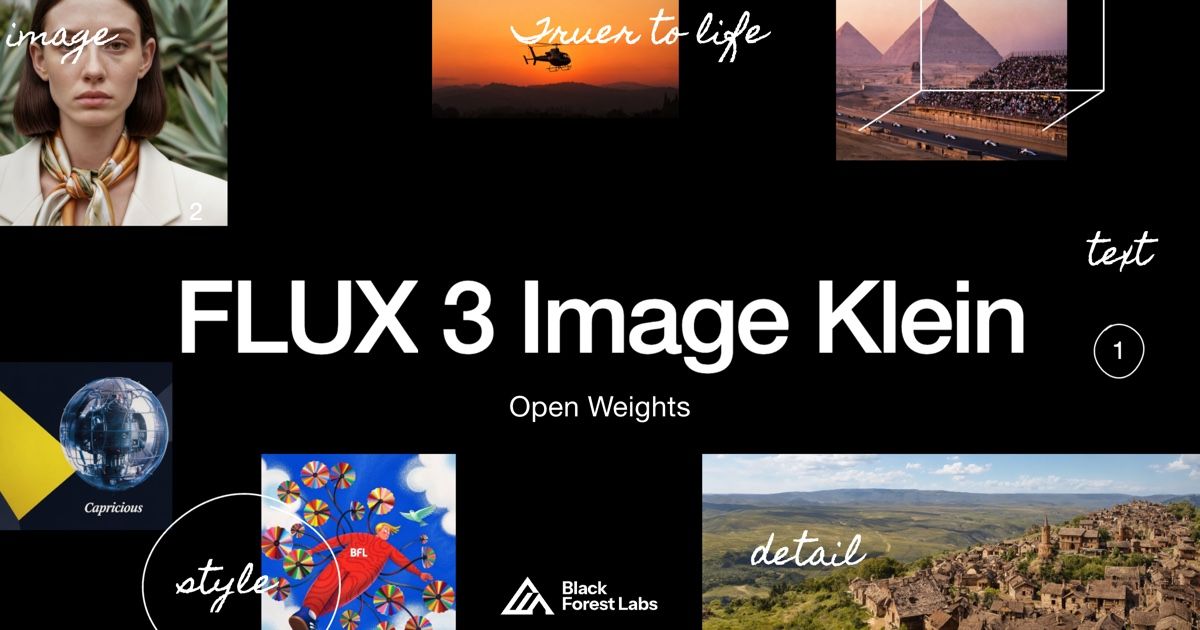
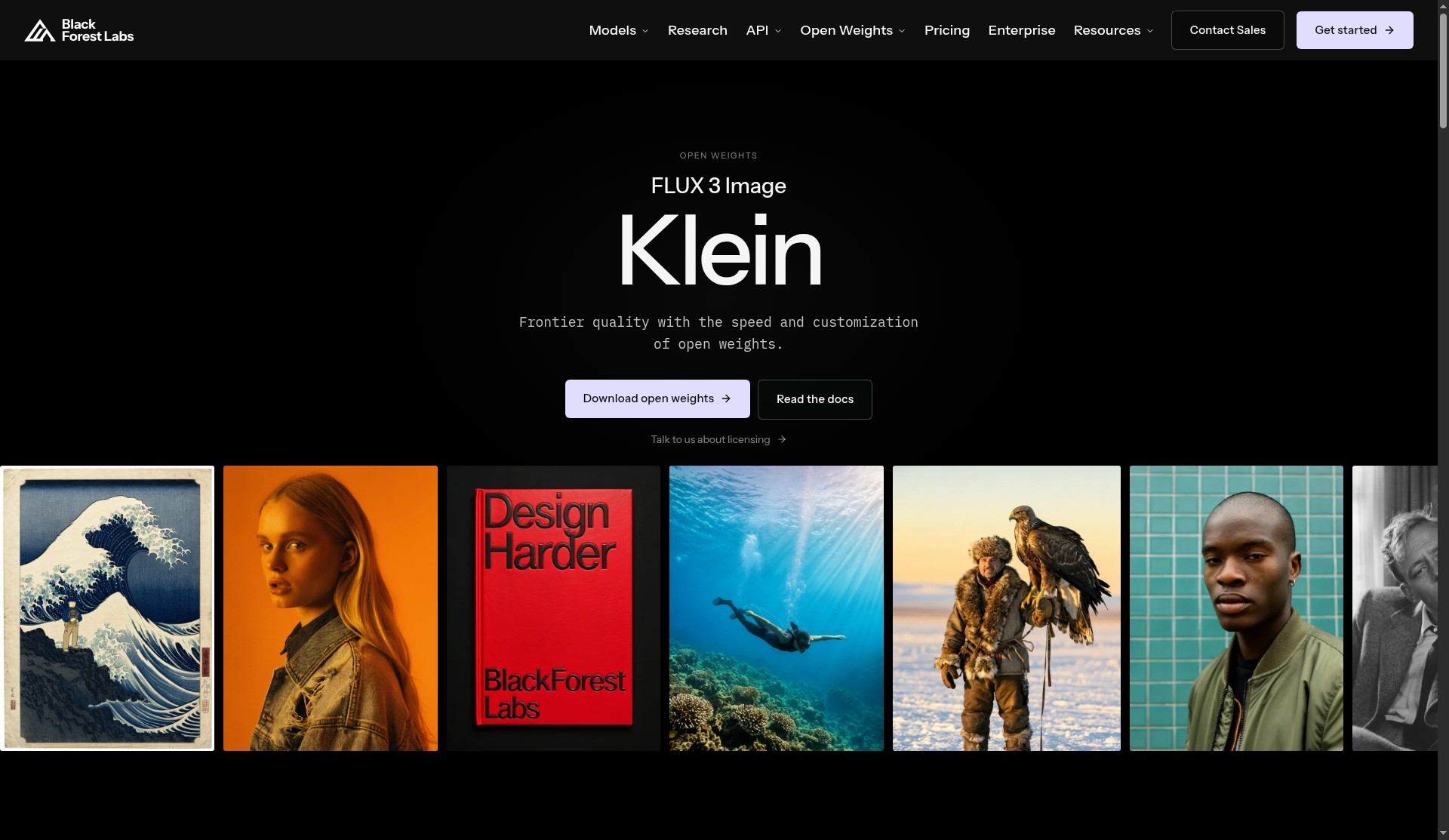
FLUX 3 Image Klein is Black Forest Labs’ compact open-weights member of the FLUX 3 Image family: a 5.6B image transformer for text-to-image, image editing, and multi-reference generation. People searching flux.3 klein (or FLUX 3 Image Klein) usually want parameter count, license, consumer-GPU VRAM, ComfyUI day-one support, and how it differs from the larger hosted FLUX 3 Image API model.
Facts below come from BFL’s launch blog (Oct 15, 2026), the product page, the Hugging Face model card, and Comfy’s FLUX 3 Image Klein page.
What Klein is (and is not)
Klein shares core FLUX 3 Image capabilities in a smaller open package: native 4K generation, pixel-oriented editing, bounding-box layout/edit control, and up to 10 reference images. The 5.6B label is the image generator; the text encoder is separate (Qwen3-VL-4B-Instruct on the HF card). It is not the same as ComfyUI’s FLUX 3 Image Partner Node, which calls BFL’s hosted larger FLUX 3 Image API.
- Base (undistilled): ~50 steps / guidance 3.5 — fine-tuning, LoRA, research
- Distilled: ~16 steps, no guidance — low-latency generation/editing; also the checkpoint behind the BFL API id
flux-3-image-klein - Quantized builds: FP8, INT8, NVFP4 (NVIDIA-supported) for smaller VRAM
- Day-one runtimes called out by BFL: ComfyUI, Diffusers, TensorRT-LLM, SGLang Diffusion, vLLM-Omni
Speed, VRAM, and quality claims (vendor-stated)
BFL’s blog states generator weights need about 11.2 GB BF16 and 5.6 GB FP8. With the INT8 build, Klein is described as runnable on NVIDIA GeForce RTX GPUs with as little as 8 GB VRAM via ComfyUI or Diffusers. NVIDIA-measured ComfyUI timings (step-distilled, 16 steps, 1 MP): about 4 seconds on an RTX 5090 and under 9 seconds on an RTX 4070. On NVIDIA GB300, the distilled model is claimed under 0.6 seconds per 1 MP image in NVFP4.
In BFL’s internal comparisons, Klein (5.6B) ranks ahead of larger open weights such as Qwen-Image 2.1 (7B) and Krea 2 (12.9B) on text-to-image / multi-reference / editing axes they report, and vs FLUX.2 [klein] 9B they cite +91 Elo text-to-image and +70 image editing with 38% fewer parameters. Treat Elo/latency charts as vendor evaluation, not an independent benchmark on your prompts.
HF reference-code peak memory (B200, 1024×1024, prompt upsampler off) is listed as 31 GB BF16 / 26 GB FP8 / 25 GB NVFP4, with the upsampler adding ~28 GB on an 80 GB GPU—numbers that differ from the consumer “8 GB INT8” path because setup, upsampler, and resolution change the footprint. Prefer the build and resolution you actually run.
Prompt upsampling and bounding boxes
Both BFL and Hugging Face warn: do not send short prompts as typed without an upsampler. Klein expects full scene captions. BFL ships flux-3-image-klein-pup; Comfy loads related CLIP with type flux3. Boxes use a 0–1000 grid; product FAQ writes each box as [y_min, x_min, y_max, x_max]. Boxes guide placement/scale—they are not hard pixel masks (elements may spill; tiny elements may vanish).
API pricing and license
- BFL API (distilled): pricing starts at $0.009 per 1K image, with prompt upsampling and pixel restoration called out in the blog
- FLUX Kommunity License: free non-commercial use; commercial output exception for Qualifying Users under US$5M annualized revenue (affiliates included), subject to license terms—commercial fine-tunes / broader product use need BFL licensing
- Text encoder Qwen3-VL-4B-Instruct is Apache-2.0 per the model card
ComfyUI practical notes
Comfy’s launch page says to update ComfyUI, download weights from Hugging Face, and load the FLUX 3 Image Klein template. Loaders: Load Diffusion Model for the checkpoint, Load CLIP with type flux3 for the Qwen3-VL 4B encoder, and Load VAE. No API key is required for local weights. Distilled vs base both run on the same loaders; INT8/FP8/NVFP4 variants reduce memory. Local generation has no per-image fee beyond hardware; Comfy Cloud still consumes plan compute. Commercial use of outputs under the Kommunity License still depends on your revenue and the license’s filtering/disclosure conditions—even when the workflow itself is free to run.
If you need the larger closed FLUX 3 Image feature set via API, use the Partner Node instead of Klein weights; they are different products sharing a family name.
Who should try it
- Teams that want one open model for generate + edit + multi-reference on their own GPUs
- ComfyUI creators comparing against FLUX.2 [klein] who need boxes and native 4K
Caveats: Safety/red-team claims are BFL’s (partner Cinder). Out-of-scope uses are spelled out in the Kommunity License (e.g., certain surveillance/biometric and CSAM/NCII prohibitions). Always read the live LICENSE on Hugging Face before shipping a product.
Bottom line
FLUX 3 Image Klein is the FLUX 3 family’s practical open-weights image model: 5.6B generator, base + distilled + quant packs, ComfyUI/Diffusers day-one paths, and Kommunity licensing with a clear revenue threshold. Download from Black Forest Labs’ HF repos and verify license fit before commercial deployment.
Sources
- BFL blog: FLUX 3 Image Klein
- BFL models: FLUX 3 Image Klein
- Hugging Face: black-forest-labs/flux-3-image-klein
- Comfy: FLUX 3 Image Klein
Sources verified Oct 19, 2026 (Pacific Time)