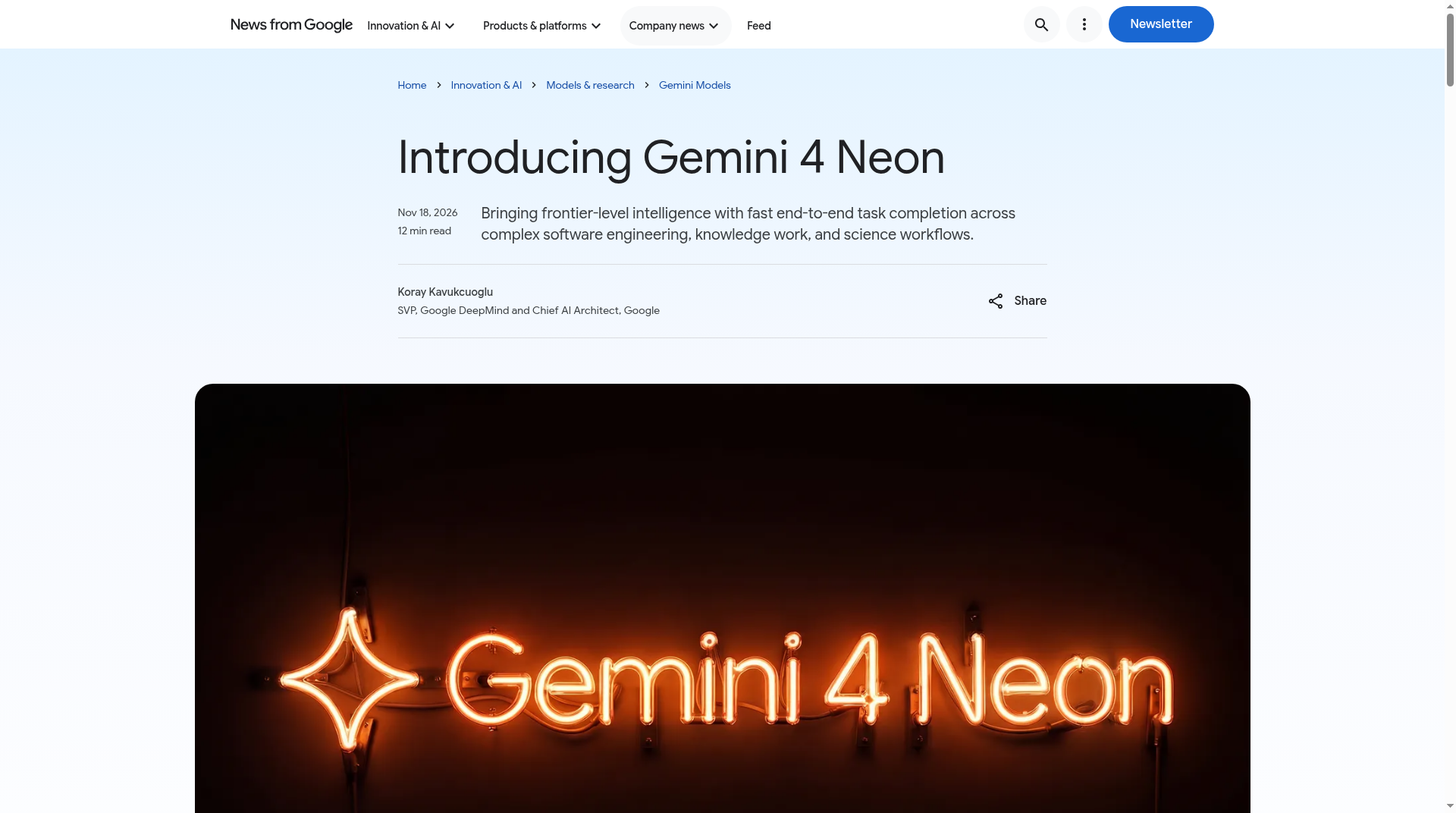
Gemini 4 Neon is now generally available. On November 18, 2026, Google DeepMind introduced it as a Gemini 4 model for complex software engineering, knowledge work, and science workflows that need frontier-level reasoning without always paying Carbon’s full depth and latency. The Gemini API model ID is gemini-4-neon. Official docs place it between Gemini 4 Hydrogen (fast everyday work) and Gemini 4 Carbon (the hardest long-horizon projects).
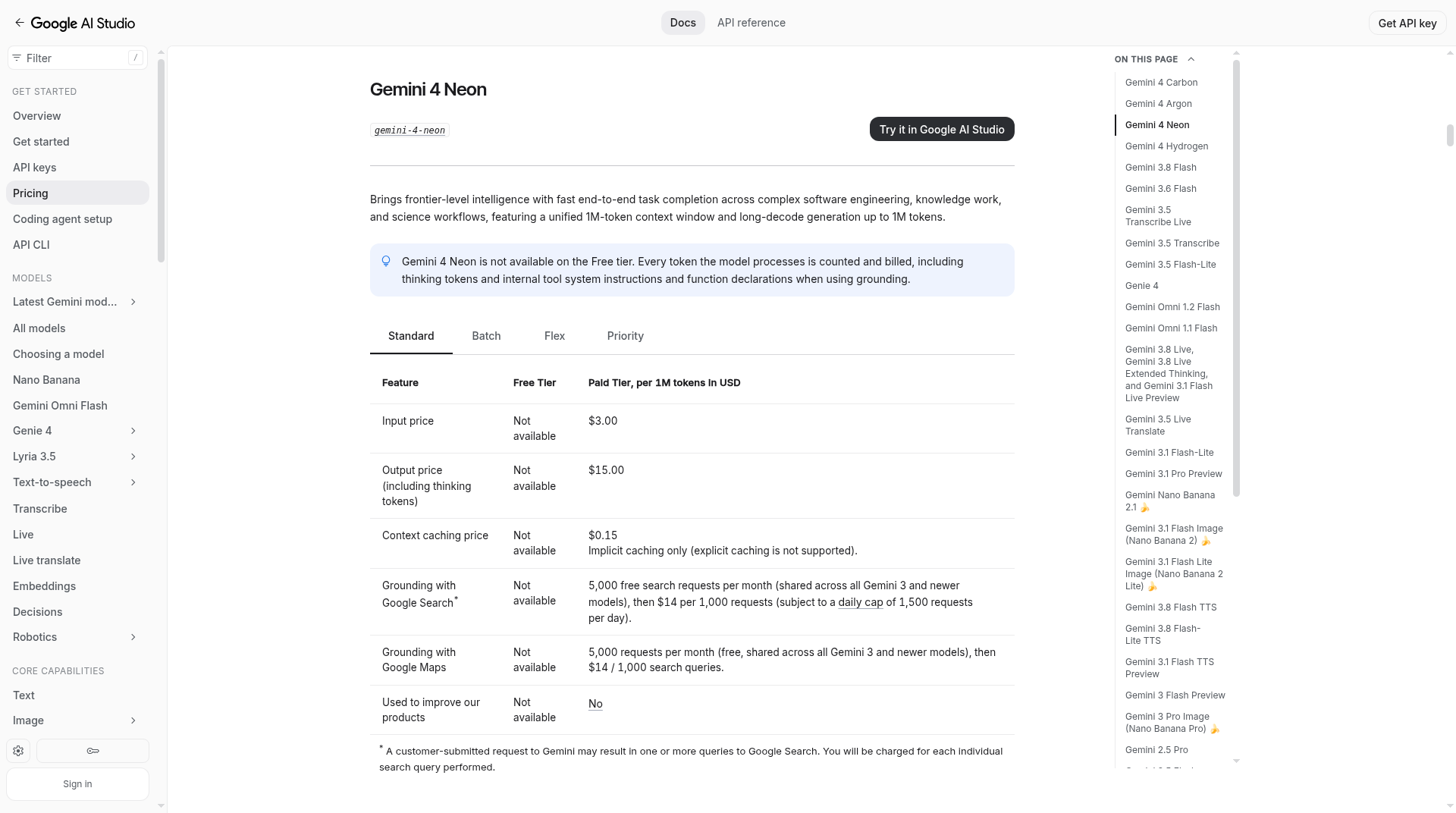
The useful question is not whether Neon “replaces” Carbon. It is when Neon is the better default. Official Standard API rates are a flat $3 per million input tokens and $15 per million output tokens, with implicit cached input at $0.15 per million tokens (a 95% discount). That list price is higher than Carbon’s introductory $2 / $10 rates through November 30, 2026, and lower than Carbon’s $4 / $20 public-access rates starting December 1. Google also says that at Neon’s default high thinking level, cost per task is 32% lower than Carbon—because of token use, not because the sticker price is lower today. Those efficiency and benchmark figures are vendor-reported; the official price list, model docs, and availability details are enough to choose a default.
What Google announced on November 18
The official announcement, signed by Koray Kavukcuoglu, describes Neon as bringing “frontier-level intelligence with fast end-to-end task completion.” Google says the model can synthesize spreadsheets, PDFs, charts, audio, and video in a single 1 million-token context window and turn those inputs into structured deliverables. In Google Antigravity, official copy positions Neon either as a standalone model for long-running, tool-heavy coding sessions or as a fast orchestrator that can direct parallel Hydrogen subagents.
The same day’s Antigravity blog post adds a product detail that matters for daily use: Orchestrator can pair Neon as the planner with Hydrogen as the executor in one session. Neon handles planning, architecture, and harder reasoning; Hydrogen takes routine edits, package updates, and test runs, and hands back to Neon if it gets stuck. Starting November 18, Google says Neon is rolling out to paid Google AI Pro and Ultra subscribers in the Antigravity desktop app, CLI, and IDE extensions, and to enterprises through Gemini for business.
The Gemini API changelog marks gemini-4-neon as generally available (GA) on November 18, 2026, on the paid tier, with four thinking levels, a unified 1M-token context window, and long decode up to 1M tokens.
Official specs
The figures below come from the official Gemini 4 Neon model page and the DeepMind model card (published November 18, 2026). The model card also notes that Neon is adapted from Gemini 4 Carbon, and that the knowledge cutoff is March 2026, with the usual caveat that some domains may be less current.
| Spec | Gemini 4 Neon |
|---|---|
| Model ID | gemini-4-neon (stable) |
| Role (Google’s wording) | Complex coding, analytical reasoning, and production-grade enterprise workflows; balances depth and efficiency |
| Inputs | Text, image, video, audio, and PDF |
| Output | Text (image generation, audio generation, and the Live API are listed as not supported) |
| Context window | Unified 1,048,576 tokens across input, thinking, and output |
| Max output | 65,536 tokens for default synchronous requests; up to 1,048,576 with long decode (background execution or client-side continuation) |
| Thinking levels | low, medium, high (default), and xhigh |
| Caching | Implicit context caching only (explicit cachedContents is not supported) |
| Also listed as supported | Code execution, computer use, file search, function calling, grounding with Google Search and Maps, structured outputs, URL context, tool retrieval (preview), agentic video understanding (defaults to static), Batch API, Flex inference, and Priority inference |
Official docs say the four thinking levels are the main control over quality, latency, and token spend. Start with high for most complex work. Reserve xhigh for hard, multi-step engineering, analytical, or scientific problems where high falls short; it uses more tokens and adds latency. medium is described as a fit for interactive coding and latency-sensitive tool calls; low is for cost- and latency-sensitive workloads. Unlike Carbon and Argon, which official migration notes say default to medium and cap at high, Neon defaults to high and adds xhigh.
Official API pricing
Neon is available on the paid tier of the Gemini API only—not the free tier. The Gemini API pricing page lists flat Standard rates across the full 1M context window. Output prices include thinking tokens. Every token the model processes is billed, including thinking tokens and, when grounding is used, internal tool system instructions and function declarations. Implicit caching discounts cached input by 95% on cache hits; official migration guidance says implicit caching runs by default on prompts of at least 4,096 tokens.
| Tier (paid, USD per 1M tokens) | Input | Output (incl. thinking) | Cached input (implicit only) |
|---|---|---|---|
| Standard | $3.00 | $15.00 | $0.15 |
| Batch | $1.50 | $7.50 | $0.075 |
| Flex | $1.50 | $7.50 | $0.075 |
| Priority | $5.40 | $27.00 | $0.27 |
Grounding with Google Search and Maps follows the shared Gemini 3-and-newer tool rates on the same pricing page: 5,000 free requests per month, then $14 per 1,000 queries, with Search also subject to a documented daily cap. Paid-tier Neon traffic is described as not used to improve Google’s products. Always recheck the live pricing page before you budget; published rates can change. Unlike Carbon and Argon, the Neon table does not list a November 30 introductory window or a December 1 step-up.
For context, official Standard list prices for the rest of the Gemini 4 family currently are: Hydrogen at $1.50 input / $7.50 output on the paid tier (Hydrogen is also listed as free of charge on the free tier); Carbon and Argon at $2 / $10 through November 30, 2026, then $4 / $20 starting December 1.
Where Neon sits versus Carbon and Hydrogen
The announcement and the What’s new in Gemini 4 Neon guide use the same split:
- Use Hydrogen as the default for everyday coding and agentic workflows, or keep Gemini 3.5 Flash-Lite for high-volume, low-latency tasks.
- Use Neon for complex software engineering, knowledge work, and science workflows where you want frontier-level quality with faster end-to-end task completion and leaner token use than Carbon.
- Use Carbon for the hardest architecture, debugging, science, and security problems.
Switching an existing Gemini 4 app to gemini-4-neon does not require request-schema changes, according to official migration notes, but you should set thinking_level if you do not want the new high default, and you must use a paid-tier project. Teams coming from Gemini 3 should also drop explicit context caching and sampling parameters such as temperature, top_p, and top_k, which Neon rejects or ignores as described in the docs.
Official benchmarks (treat vendor scores as vendor scores)
The model card publishes a comparison table “as of November, 2026.” Selected official figures for Gemini 4 Neon, with the card’s Claude Opus 5.5 and GPT-6.2 Sol numbers in parentheses where listed:
- Artificial Analysis Intelligence Index v5.0.1: 61 (Opus 5.5: 59; GPT-6.2 Sol: 57). The launch blog says this is Neon’s score at
xhigh, ranking #3 overall, “just behind larger, slower models.” - Vals Index v2.2: 70.9% (70.1%; 66.1%)
- Artificial Analysis Coding Agent Index: Google’s announcement cites a #1 overall score of 58.6
- Terminal-Bench 4.1 (cheating-adjusted accuracy): 65.2% (65.8%; 61.5%)
- FrontierCode 2.0: 46.2% at the default
highsetting (47.3%; 43.8%) - SWE-sweep, provider harness: 39.0% (10.1%; 8.3%); mini-SWE harness: 12.8%
- Zapier AutomationBench: 56.3% (42.5%; 41.3%)
- RiemannBench: 84.0%; Terminal-Bench-Science 0.1: 70.5%; HLE-Diamond: 71.3%
- Chartography: 73.5%; GraphWalks 256k–1M BFS (F1): 95.2%
The launch blog also says Neon ranks #2 on steerability on Arena’s Agent Arena Index (score 1336 across 4,200+ sessions), lands on the Pareto frontier of the Vals Index, and shows a 32% lower cost per task than Carbon at default high, with “roughly 50% to 80% lower cost per task than top competing frontier models” on Vals and Agent Arena. At xhigh, Google says Neon posts its highest intelligence score while still costing “36%+ less per task than competing models at their highest setting.” These are Google’s published figures and third-party benchmark numbers as reported by Google, not independent re-runs by us.
Who can use Gemini 4 Neon
Access depends on the product and the subscription tier. The November 18 announcement, the model card, and API docs together list these official channels:
- Developers: the Gemini API paid tier in Google AI Studio and Android Studio, across both
generateContentand the Interactions API. Official pricing docs state Neon is not available on the Free tier. - Google AI Pro and Ultra subscribers: Neon in Google Antigravity and AI Studio; Pro and Ultra subscribers can also select it from the model drop-down in the Gemini app.
- Enterprises: Gemini for business via the API or model drop-down, and Google Antigravity.
- Cybersecurity defenders: “Neon for cyber” is described as rolling out in the coming days to eligible members of Google’s Fairwind Program, via a Cloud account team request. This article does not cover offensive techniques.
Safety notes and limitations
The model card’s known limitations include hallucinations, ongoing jailbreak-resistance work, and the March 2026 knowledge cutoff. The full Gemini 4 Neon Safety & Security Report was listed as “coming soon” on the card at the time we checked. High-level claims from the announcement and model card include Carbon-level protections against severe misuse and prompt injection, a reported 0.0% attack success rate on Gray Swan’s indirect prompt-injection benchmark at the highest thinking level with real-time safeguards, and lower under-service and overreach rates than Carbon on Google’s internal agentic-behavior evaluation. Google also says a Material Capability Change assessment found an increase versus Gemini 4 Argon that still fell below its Frontier Safety Framework threshold, so it carries forward Argon’s critical-capability determinations. Dual-use cybersecurity capabilities are limited to verified Fairwind defenders; treat those vendor scores as vendor scores.
Should you switch from Carbon or Hydrogen?
Stay on Hydrogen if the work is everyday coding, quick agent loops, or high-volume tasks where speed and a lower list price matter. Hydrogen remains the official default for those workflows and is the only Gemini 4 model in this set with a free API tier.
Try Neon if you already have paid Gemini API, Gemini for business, or Google AI Pro/Ultra access and your work is frequent but genuinely complex—repository-level debugging and refactoring, dense document and spreadsheet analysis, or science and quantitative tasks where you want more headroom than Hydrogen without always spending Carbon-level tokens. Budget for thinking tokens, especially at xhigh, and remember that Neon’s $3 / $15 Standard list price is not a discount to Carbon’s current introductory $2 / $10 rates.
Keep Carbon for the hardest long-horizon projects, and remember that Carbon’s Standard public-access rates are scheduled to move to $4 / $20 on December 1, 2026. If cost per completed task is what you care about, Google’s own claim is that Neon at default high is already cheaper per task than Carbon; that is a vendor-reported efficiency claim, so run your own evaluations before you migrate production traffic.
Primary official links: the November 18 announcement, the What’s new in Gemini 4 Neon guide, the model page, the API pricing page, the DeepMind model card, and the Antigravity launch post.
Sources
This review is based on official Google and Google DeepMind documentation: the November 18, 2026 announcement of Gemini 4 Neon, the What’s new in Gemini 4 Neon API guide, the Gemini 4 Neon model page, the Gemini API pricing page, the Gemini API changelog, the Gemini 4 Neon model card, and the Google Antigravity launch post.
Sources verified Nov 21, 2026 (Pacific Time): Google blog, “Introducing Gemini 4 Neon,” dated Nov 18, 2026; Google AI Studio, “What’s new in Gemini 4 Neon”; Google AI Studio, “Gemini 4 Neon” model page; Gemini API, “Pricing,” Gemini 4 Neon section; Gemini API, “Release notes,” November 18, 2026 entry; Google DeepMind, Gemini 4 Neon model card, published 18 November 2026; Google Antigravity blog, “Gemini 4 Neon in Google Antigravity,” dated Nov 18, 2026.