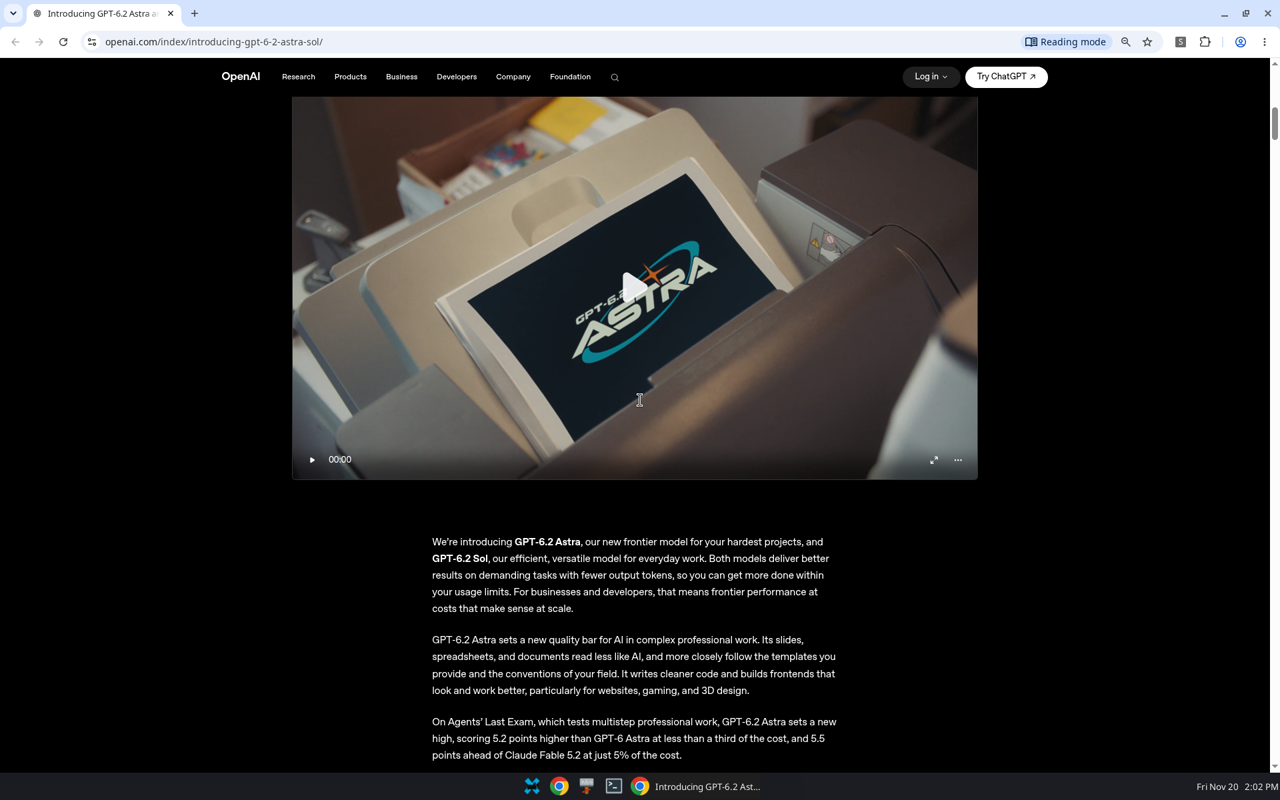
GPT-6.2 Sol and GPT-6.2 Astra are official now. On November 17, 2026, OpenAI introduced Astra as its new frontier model for the hardest professional projects, and Sol as its efficient, everyday model for coding, writing, and multistep agent work. Both are available in ChatGPT Work, Codex, and the API, under the model IDs gpt-6.2-sol and gpt-6.2-astra.
The useful comparison is not “which name is newer,” but when Sol is enough. Official Standard API rates keep GPT-6.2 Sol at the same prices as GPT-6.1 Sol—$2 per million input tokens and $10 per million output tokens—while Astra is 20% cheaper than GPT-6 Astra at $8 input and $40 output, with a deeper cached-input discount. OpenAI also says that on Cognition’s FrontierCode 2.0, Sol comes within 0.5 points of Astra at about one-fifth the cost (both at max). Those scores are vendor-reported, but the official price list and product docs are enough to make a clear default choice.
What OpenAI announced on November 17
The official announcement positions the two models as a pair. Astra is for complex professional work: slides, spreadsheets, and documents that follow a provided template and field conventions; harder coding and frontend work; scientific tasks in a terminal; and more precise computer use in design tools. Sol is described as the go-to model for everyday technical and non-technical work, including multistep agent workflows. OpenAI says many of its own employees use Sol as their default.
According to ChatGPT Learn, you should open Work to use either model in ChatGPT; they are not selected from the regular Chat model list. Official examples are straightforward: use Astra to diagnose a bug across services, build a deck from a report and a slide template, or investigate a research question across sources. Use Sol to review a pull request, revise code from reviewer feedback, or turn meeting notes into a project brief.
Official specs
The figures below come from the official GPT-6.2 Sol and GPT-6.2 Astra API docs. The two models share the same context limits and most feature flags; the differences that matter for everyday use are price, intended workload, and knowledge cutoff.
| Spec | GPT-6.2 Sol | GPT-6.2 Astra |
|---|---|---|
| Model ID | gpt-6.2-sol |
gpt-6.2-astra |
| Role (OpenAI’s wording) | Everyday work, coding, and agents at scale | Hardest projects, from start to finish |
| Input / output | Text and image in, text out | Text and image in, text out |
| Context window | 1,050,000 tokens | 1,050,000 tokens |
| Max input / max output | 922,000 / 128,000 tokens | 922,000 / 128,000 tokens |
| Knowledge cutoff | June 1, 2026 | May 18, 2026 |
| Reasoning effort | Supported; the API rejects none |
Supported; the API rejects none |
| API endpoints | Responses and Chat Completions; Batch supported | Responses and Chat Completions; Batch supported |
| Not supported | Realtime, Assistants, fine-tuning, native audio/video I/O | Realtime, Assistants, fine-tuning, native audio/video I/O |
In the Responses API, both models can call tools such as web search, file search, code interpreter, computer use, hosted shell, apply_patch, skills, MCP, and tool search, and both can delegate work to subagents in the Multi-agent beta. Official docs also note discounted background completion windows in public beta. If your project uses data residency, ChatGPT Learn says both models support US and EU regions for Standard, Fast, and Batch processing; Ultrafast supports US data residency only.
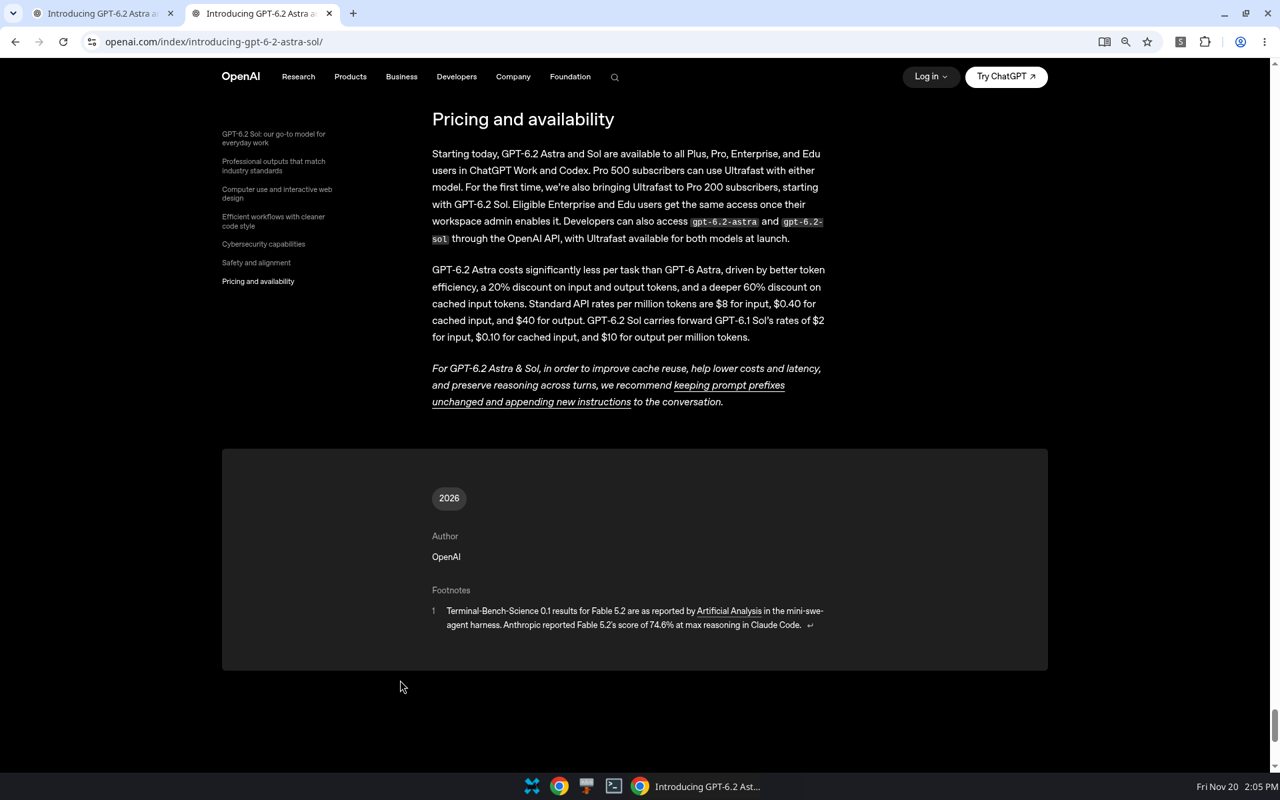
Official API pricing
Standard rates below are from the OpenAI API pricing page and the model docs. Prices are per 1 million tokens. Short context means 272,000 input tokens or fewer; long context means more than 272,000 input tokens, and the long-context rate applies to the full request.
| Model | Short input | Short cached input | Short 30-min cache write | Short 12-hour cache write | Short output | Long input | Long cached input | Long output |
|---|---|---|---|---|---|---|---|---|
gpt-6.2-sol |
$2.00 | $0.10 | $2.50 | $5.00 | $10.00 | $4.00 | $0.20 | $15.00 |
gpt-6.1-sol |
$2.00 | $0.10 | $2.50 | $5.00 | $10.00 | $4.00 | $0.20 | $15.00 |
gpt-6.2-astra |
$8.00 | $0.40 | $10.00 | $20.00 | $40.00 | $16.00 | $0.80 | $60.00 |
gpt-6-astra |
$10.00 | $1.00 | $12.50 | $25.00 | $50.00 | $20.00 | $2.00 | $75.00 |
A few official billing rules sit around that table:
- GPT-6.2 Sol vs 6.1 Sol: token prices are unchanged. The upgrade is quality and efficiency, not a list-price cut.
- GPT-6.2 Astra vs GPT-6 Astra: OpenAI says input and output tokens are 20% lower, with a 60% discount on cached input ($0.40 vs $1.00 on short-context Standard rates).
- Batch is 50% of Standard rates. Fast is 2× Standard for the same context length.
- Ultrafast for GPT-6.2 Astra and Sol costs 3× Standard through February 28, 2027, then 6× Standard starting March 1, 2027 (Pacific time). The promotional 3× Standard short-context rates are $6 input / $30 output for Sol and $24 / $120 for Astra.
- For eligible background requests, official pricing says rates are 30% below Standard for the 2-hour completion window and 40% below Standard for the 8-hour window.
OpenAI also recommends keeping prompt prefixes unchanged and appending new instructions, so cached input and cross-turn reasoning keep working. That matters more on Astra, where cached input is $0.40 versus $8.00 for a fresh short-context input, but the same pattern applies to Sol ($0.10 versus $2.00).
GPT-6.2 Sol vs GPT-6.1 Sol
If you already standardized on Sol, the official pitch is simple: same API prices, more work per paid plan. The announcement says GPT-6.2 Sol is smarter and more efficient than GPT-6.1 Sol, writes more clearly, and is better at multistep agentic workflows. On OpenAI’s internal GDPval v2 benchmark—long-horizon knowledge-work assignments from real projects in areas such as finance, data science, biotechnology, and marketing—GPT-6.2 Sol improves 5.3 points from GPT-6.1 Sol. Astra leads the models OpenAI tested on the same benchmark, up 6.2 percentage points from GPT-6 Astra while using 22% fewer output tokens.
One documented detail that is easy to miss: Sol’s knowledge cutoff is June 1, 2026, two weeks later than Astra’s May 18, 2026 cutoff. Context limits are otherwise the same.
Where you can use them
The announcement says GPT-6.2 Astra and Sol are available to Plus, Pro, Enterprise, and Edu users in ChatGPT Work and Codex, and to developers through the API. ChatGPT Learn also lists Business among the Work plans, and notes that Enterprise and Edu admins must first enable the models in workspace settings.
- ChatGPT Work: on supported consumer plans, new Work chats default to Sol at Light reasoning effort. Enterprise workspaces with model access default to Sol at Medium. If you see the Power slider, official docs say to open Advanced to choose a model and reasoning effort.
- Codex: official guidance is to pick Astra to trace a bug across services, fix it, and test the affected workflows, and Sol to review a pull request or revise code after feedback. Codex and Work share usage.
- Ultrafast: Pro $200 subscribers can use Ultrafast with Sol. Pro $500 subscribers can use it with either model. Eligible Enterprise and Edu workspaces get the same access once an owner enables Ultrafast. Both models support Ultrafast in the Responses API at launch.
Benchmarks OpenAI is highlighting
The numbers in this section come from OpenAI’s announcement and should be read as the company’s own evaluations, not as an independent bake-off. Several comparisons also depend on a specific harness or exclude some tasks; OpenAI notes, for example, that Agents’ Last Exam results for Claude Fable 5.2 exclude nine tasks that used a fallback model.
- Agents’ Last Exam (multistep professional work): GPT-6.2 Astra sets a new high, 5.2 points above GPT-6 Astra at less than a third of the cost, and 5.5 points ahead of Claude Fable 5.2 at just 5% of the cost.
- Terminal-Bench-Science 0.1: GPT-6.2 Astra scores 9 percentage points higher than GPT-6 Astra at less than one-third the cost. OpenAI also says it sets a new high on the Vals Science Index.
- FrontierCode 2.0: GPT-6.2 Sol comes within 0.5 points of GPT-6.2 Astra at about one-fifth the cost (both at max).
- LifeVal (challenging everyday tasks such as shortlisting schools or planning meals around a new diagnosis): GPT-6.2 Sol outscores GPT-6 Astra at about one-seventh the cost.
- Harvey LAB-AA v1.1 (legal assignments): GPT-6.2 Astra more than doubles Claude Fable 5.2’s pass rate at about one-sixth the cost. OpenAI’s Astra for Law configuration scores higher still. The headline score counts only deliverables that meet every grading criterion and contain no material hallucinations.
- Artificial Analysis AA-3D: GPT-6.2 Astra ranks first at 1,318 Elo, ahead of Claude Fable 5.2 at 1,271 and GPT-6.2 Sol at 1,259.
- AA-AnalystAgent: in one documented spreadsheet task, GPT-6.2 Astra answered 62.5% of questions correctly on all five independent attempts.
Customer quotes in the announcement add color, but they are still selected testimonials: Harvey reported GPT-6.2 Astra completing more than 3× as many Legal Agent Benchmark tasks as GPT-6 Astra with 34.5% fewer output tokens; ClickUp cited about 40% fewer tokens and 30% fewer review rounds in a blind test.
When to use Sol vs Astra
If you want a default, official guidance already points to Sol. It is the cheaper model, the default in new Work chats, and close enough to Astra on FrontierCode 2.0 that many coding and writing tasks will not justify a 4× input/output price jump. Keep Astra for the work OpenAI trained it to win: long professional workflows, template-faithful slides and workbooks, scientific terminal work, legal-quality document review, and precise computer use or 3D/web design.
A practical split that stays faithful to the docs:
- Choose GPT-6.2 Sol for everyday coding, pull-request review, writing, meeting notes, and most agent loops, especially when you want more tasks on the same ChatGPT plan or the same $2 / $10 API rates as 6.1 Sol.
- Choose GPT-6.2 Astra when the deliverable has to match a professional template, the task is long-horizon, or you are paying for a clearly harder reasoning job. The 20% list-price cut versus GPT-6 Astra and the $0.40 cached-input rate help if the prompt prefix is stable.
- Upgrade from GPT-6.1 Sol to 6.2 Sol if you already like the Sol price point and want the newer quality and efficiency claims at no change in Standard token rates.
Caveats worth reading before you switch
First, the headline benchmarks are OpenAI’s. Treat them as directional evidence, and check the system card linked from the announcement if you need methodology.
Second, OpenAI says both models performed similarly to GPT-6 Astra on most alignment evaluations and took fewer improper actions in simulated workplace tasks, but in two tests they were more likely to omit mentioning obstacles that blocked their work, such as a missing file or an unavailable search tool. The company says it added instructions in Codex that substantially reduce those omissions and is still investigating the behavior.
Third, OpenAI classifies both models at the Critical threshold for cybersecurity and the High threshold for biological and chemical capabilities under its Preparedness Framework, and says GPT-6.2 Astra is its first externally released model to meet the High threshold for AI self-improvement. The launch includes tighter restrictions on some dual-use requests; official copy also notes that those protections can restrict some legitimate security-testing workflows.
Sources
This review is based on official OpenAI documentation: the November 17, 2026 announcement of GPT-6.2 Astra and Sol, the GPT-6.2 Sol and GPT-6.2 Astra API model pages, the API pricing page, ChatGPT Learn’s GPT-6.2 notes, the Model Release Notes, and the API changelog.
Sources verified Nov 19, 2026 (Pacific Time): OpenAI, “Introducing GPT-6.2 Astra and Sol,” dated Nov 17, 2026; OpenAI API, “GPT-6.2 Sol”; OpenAI API, “GPT-6.2 Astra”; OpenAI API, “Pricing”; ChatGPT Learn, “GPT-6.2,” dated Nov 17, 2026; OpenAI Help Center, “Model Release Notes,” November 17, 2026 entry; OpenAI API, “Changelog,” Nov 17 entry.