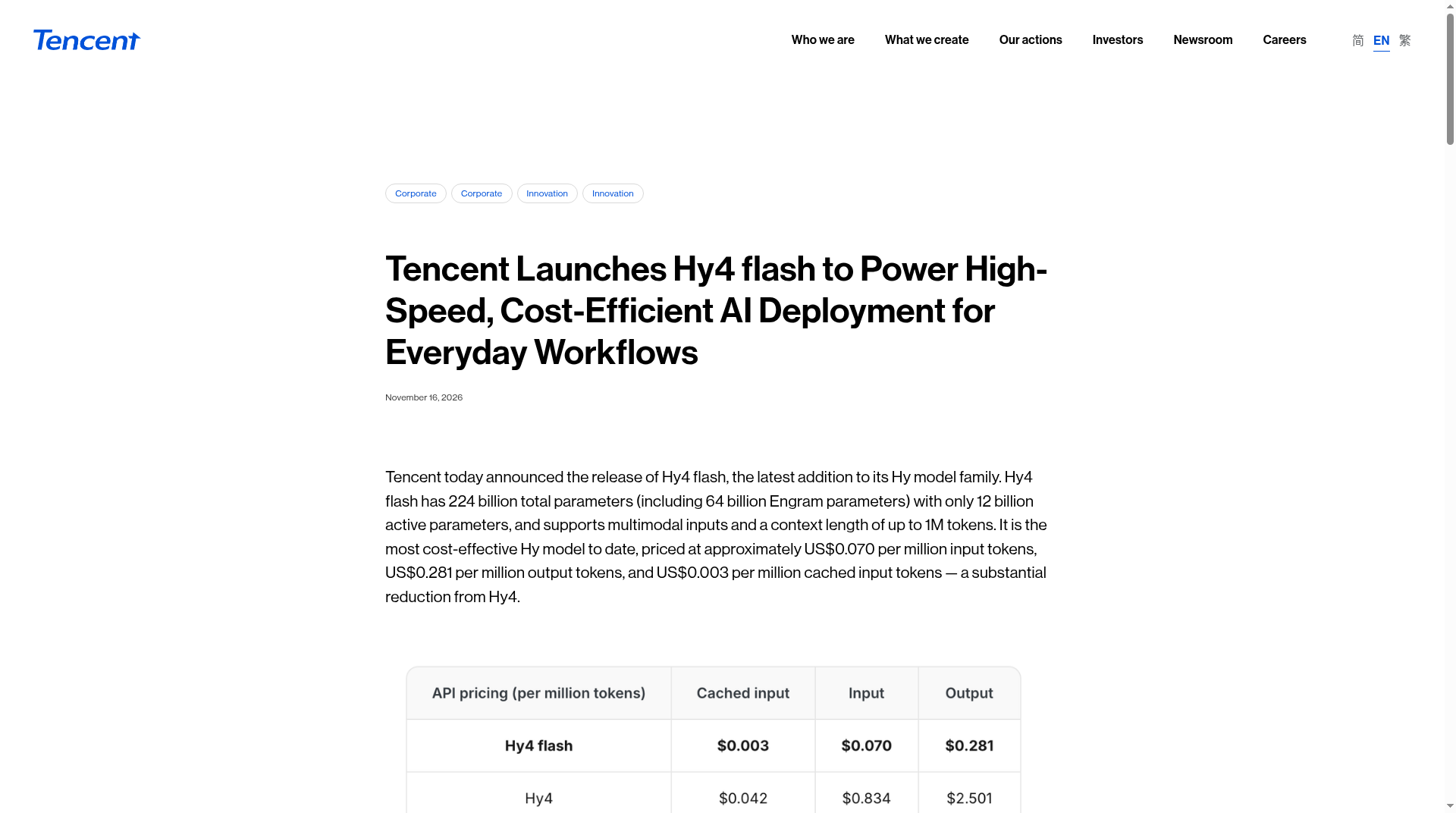
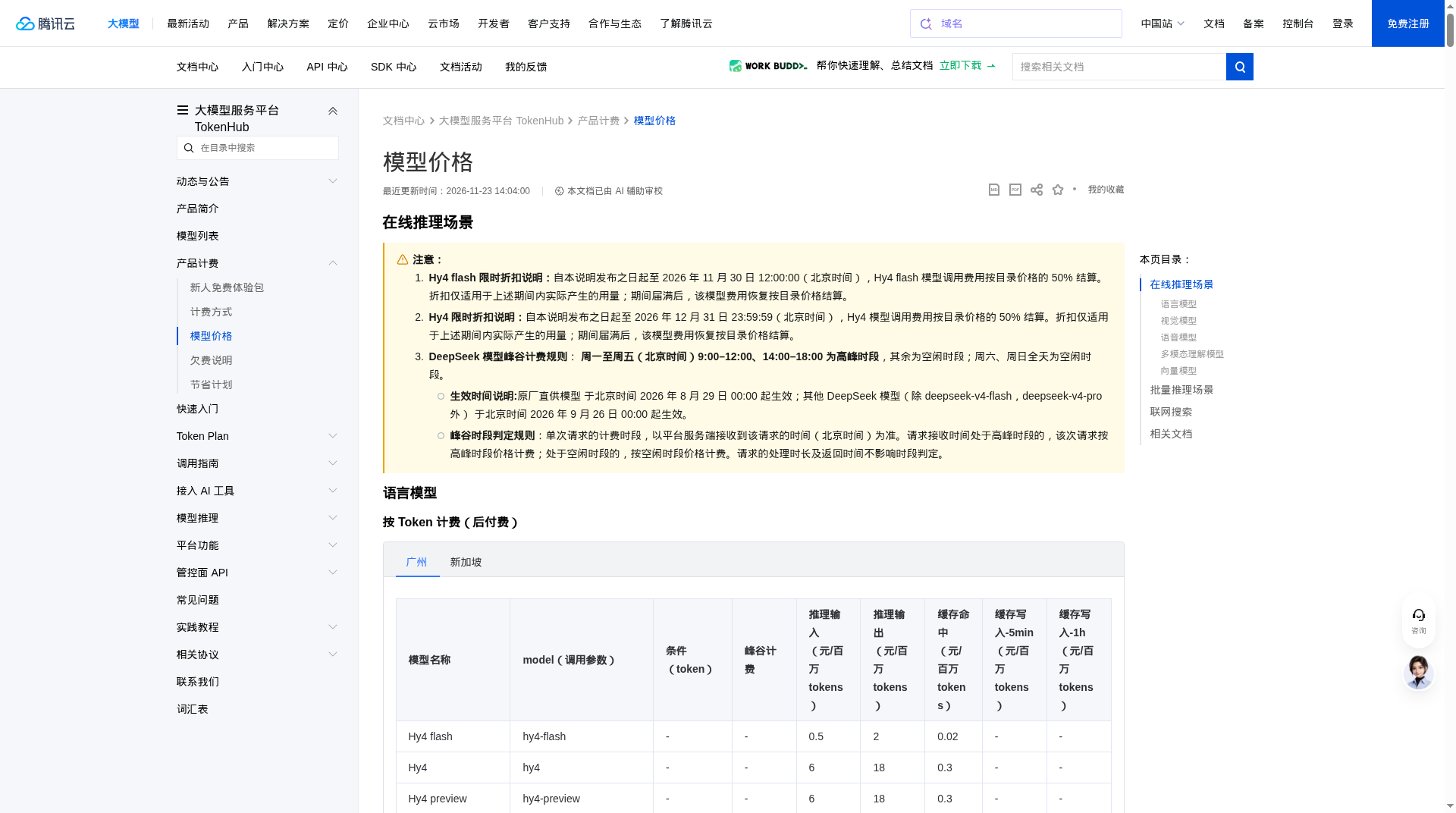
Hy4 flash is now official. On November 16, 2026, Tencent announced it as the most cost-effective model in the Hy family: a multimodal Mixture-of-Experts model with a 1 million-token context window, priced at US$0.070 per million input tokens, US$0.281 per million output tokens, and US$0.003 per million cached input tokens, versus official USD list rates of $0.834 / $2.501 / $0.042 for Hy4. The official Tencent Cloud TokenHub price list, last updated November 23, 2026, lists the same model under the ID hy4-flash at ¥0.5 / ¥2 / ¥0.02 per million tokens for input, output, and cache hits, with a 50 percent discount through 12:00 Beijing time on November 30, 2026. Open weights for Hy4 flash, Hy4 flash-FP8, and the pre-trained Hy4 flash-base are on Hugging Face, ModelScope, and GitCode; Tencent’s open-source model index dates that drop to November 18, 2026.
The useful comparison is not whether flash “replaces” Hy4. Official guidance is to use Hy4 flash for most everyday productivity work—deep research, document processing, slide decks, simple front-end demos, and computer use—and to keep Hy4 for complex, long-horizon software engineering. Vendor-reported WorkIndex scores and a WorkBuddy blind evaluation are summarized below and labeled as such. The official price list, model card, license, and availability details are enough to choose a default.
What Tencent announced on November 16
The official Tencent announcement presents Hy4 flash as a practical, lower-cost follow-on to Hy4, which Tencent says was released on November 4, 2026. The news post gives a headline size of 224 billion total parameters (including 64 billion Engram parameters) with only 12 billion active parameters, plus native multimodal inputs and a context length of up to 1 million tokens. The official Hugging Face model card and GitHub README describe the same design as 220 billion total parameters (including 64 billion Engram parameters) with 12 billion active parameters per token. Those two official totals differ slightly depending on how Engram and add-on modules are counted; the model card’s component table is the more detailed breakdown and is quoted in the next section.
Tencent says Hy4 flash is available on Tencent Cloud TokenHub, WorkBuddy, Yuanbao, WeCom, QQ, ima, and Marvis, with OpenRouter integration “coming soon” as of the November 16 post. Through November 30, the same announcement offers Hy4 flash for free on WorkBuddy and a 50 percent discount on standard TokenHub pricing. Tencent also wrote that it planned to open-source the model; the Tencent Hy open-source model page later lists “LLM Hy4 flash” with the date November 18, 2026, and the official repositories already host the instruct, FP8, and base checkpoints.
Official specs and how flash differs from Hy4
According to the official model card, Hy4 flash accepts text and image inputs and generates text. The language backbone has 42 layers—one dense feed-forward layer and 41 MoE layers—with identity Hyper-Connections (iHC). A vision encoder, adapted from SigLIP2-So400m-Patch16-Res512, connects to the backbone through an MLP projector. A built-in 5-layer drafter, DFly2 (0.85 billion parameters), reuses the target model’s KV cache and sparse indices for long-context speculative decoding.
The model card’s specification table lists:
- Architecture: Mixture-of-Experts (MoE)
- Total parameters excluding Engram, the vision encoder, and DFly2: 155.5 billion
- Engram parameters: 63.5 billion
- Vision encoder: 0.43 billion; DFly2: 0.85 billion
- Activated parameters per token: 11.3 billion (text) + 0.43 billion (vision)
- Context length: 1,048,576 tokens
Compared with Hy4, the official README calls out three architectural changes: hybrid attention, which interleaves sparse IndexPool attention and sliding-window attention at a 1:3 ratio; LatentMoE, in which each token activates 16 of 512 routed experts plus one shared expert, with routed experts operating in a lower-dimensional latent space; and Engram n-gram embeddings (learned bigrams and trigrams retrieved with multi-head hash lookups). Tencent also says the KV cache is one-twenty-fourth the size of Hy3’s and one-sixth the size of Hy4’s. Those cache-size figures are vendor-reported.
For instruct checkpoints, official examples use reasoning_effort set to "high" (the default, with thinking enabled) or "no_think" for direct answers. Recommended sampling parameters in the README are temperature=0.9 and top_p=1.0. The Hugging Face model ID in the official quickstart is tencent/Hy4-flash; local OpenAI-compatible servers in the same docs are served as hy4-flash.
Official pricing and availability
Two official price views are worth keeping straight. The English Tencent announcement includes a USD comparison table: Hy4 flash at $0.003 cached input, $0.070 input, and $0.281 output per million tokens, versus Hy4 at $0.042 / $0.834 / $2.501. The Tencent Cloud TokenHub price list (page timestamp November 23, 2026, 14:04) is the billable catalog in yuan, for online inference in the Guangzhou region:
- Hy4 flash (
hy4-flash): ¥0.5 input, ¥2 output, ¥0.02 cache hit, per million tokens - Hy4 (
hy4): ¥6 / ¥18 / ¥0.3 - Hy4 preview (
hy4-preview): ¥6 / ¥18 / ¥0.3
A notice at the top of that same page states that from publication of the notice through 12:00:00 Beijing time on November 30, 2026, Hy4 flash is billed at 50 percent of list price. After that deadline, list price resumes. The Token Plan promo page repeats the same window, starting November 16, and shows the discounted Token Plan rates as ¥0.25 / ¥1 / ¥0.01 per million tokens (5 / 20 / 0.2 points) on the General Token Plan and Hy Token Plan. Hy4 has a separate TokenHub list-price discount through December 31, 2026; that is a Hy4 promo, not the flash window.
On the product side, the November 16 announcement also says Hy4 flash is free to use on WorkBuddy through November 30, and lists Yuanbao, WeCom, QQ, ima, and Marvis alongside TokenHub. Treat “OpenRouter coming soon” as of that announcement date unless you confirm it has since gone live.
Open weights, serving, and the Tencent Hy License
The official repositories release three open-weight variants: the instruct model Hy4 flash, an FP8 quantized instruct model Hy4 flash-FP8, and a pre-trained Hy4 flash-base checkpoint that is not instruction-tuned. They are published on Hugging Face, ModelScope, and GitCode, with the GitHub project at Tencent-Hunyuan/Hy4-flash.
For production serving, the README recommends official prebuilt images: vllm/vllm-openai:hy4-flash for vLLM and lmsysorg/sglang:hy4-flash for SGLang. A GGUF build is provided via AngelSlim at AngelSlim/Hy4-flash-GGUF, and a finetuning guide ships in the model repository. Transformers support, at the time of the official quickstart, was still being merged and pointed at a specific pull-request commit rather than a stable release tag.
Weights are released under the Tencent Hy License, Version 1.0, which is derived from Apache 2.0 with extra commercial terms in Section 10. In short, if you operate a model-as-a-service business and either your aggregate worldwide gross revenue exceeds US$50 million in any consecutive 12-month period, or a product or service you provide has more than 100 million monthly active users in any calendar month, you must obtain a separate written license from Tencent. Internal use is carved out when the work, derivatives, and their outputs are not made available to third parties. Read the license itself before you ship anything on top of the weights.
When to use Hy4 flash vs Hy4
Official copy is consistent across the news post and the model card. Use Hy4 flash as the default for everyday productivity: deep research or search, document processing, slide creation and editing, simple front-end demos, and computer use. Use Hy4 when the job is complex, long-horizon software engineering and you want a higher intelligence ceiling. Hy4 preview is still on the TokenHub price list, but it is not the model Tencent is recommending as the everyday default now that flash is out; a Token Plan promo page also notes that hy4-preview is scheduled to be retired on December 7, 2026.
That split matches the list prices. Even after flash’s November 30 discount expires, official TokenHub rates keep Hy4 flash an order of magnitude cheaper than Hy4 (¥0.5 / ¥2 versus ¥6 / ¥18 per million input / output tokens). The news post’s approximate USD figures tell the same story.
Vendor-reported evaluations (not independent audits)
Tencent’s own numbers should be read as vendor-reported. On an internal WorkIndex suite covering slide creation and editing, Markdown co-writing, document editing, spreadsheet repair, audio/video processing, and visual understanding, the model card reports a task score of 42.1 for Hy4 flash versus 39.7 for Hy4 preview and 51.4 for Hy4. The same pages claim that average cost per WorkIndex task is about 1/13 that of Hy4 preview, 1/20 that of Hy4, and 1/8 that of DeepSeek-V4.1-Flash-1017 at Max-tier, peak-hour pricing. Tencent also says reinforcement learning cut average end-to-end output tokens by 50 percent, and that combined megakernel, 4-bit quantization, and DFly2 optimizations push decoding past 150 tokens per second.
A separate blind evaluation with 85 internal WorkBuddy users, across 259 tasks in 27 categories, reports user satisfaction of 2.79 / 4 for Hy4 flash versus 2.81 / 4 for Claude Haiku 5.5, with a median end-to-end completion time of 6.7 minutes and a cost of RMB 0.26 per task—the lowest cost and shortest median time among the models Tencent says it evaluated. Those figures come from Tencent’s own users and rubric, not from a public third-party leaderboard for flash. The November 16 post’s Artificial Analysis and Agent Arena ranking claims refer to Hy4, not Hy4 flash.
If you want a cheaper everyday Hy model with official API pricing, a 1 million-token context window, and downloadable weights, Hy4 flash is the one Tencent is pointing you to. If the work is a long, hard coding project, official guidance is still to pay for Hy4.
This overview is based on official Tencent documentation: the November 16, 2026 Hy4 flash announcement, the Tencent Hy open-source model index, the Hugging Face model card for tencent/Hy4-flash, the Tencent-Hunyuan/Hy4-flash GitHub repository, the Tencent Hy License, the TokenHub model price list, and the TokenHub Token Plan promo terms.
Sources verified Nov 23, 2026 (Pacific Time): Tencent, “Tencent Launches Hy4 flash to Power High-Speed, Cost-Efficient AI Deployment for Everyday Workflows,” dated Nov 16, 2026; Tencent Hy, “Open Source Model,” listing Hy4 flash as Nov 18, 2026; Hugging Face, tencent/Hy4-flash model card; GitHub, Tencent-Hunyuan/Hy4-flash; Tencent Hy License, Version 1.0; Tencent Cloud TokenHub, “模型价格,” page updated Nov 23, 2026; Tencent Cloud TokenHub Token Plan promo terms, Hy4 flash 50% discount through Nov 30, 2026, 12:00 Beijing time.