Claude Opus 5.5 vs Fable 5.2 is the comparison most teams make after Anthropic’s November 9, 2026 launch of Claude Fable 5.2 and Claude Mythos 5.2. Official docs describe Opus 5.5, released September 22, 2026, as the everyday flagship for long-running agentic coding and knowledge work. Fable 5.2 is positioned above it for demanding reasoning and long-horizon agent work. The two models share a 1 million token context window and a 128K synchronous output limit, but they do not share a price, a default effort level, or the same data-retention rules.
Anthropic’s official guidance: start with Opus 5.5
The Fable 5.2 announcement is explicit: for most coding and knowledge tasks, start with Claude Opus 5.5—“our strongest daily driver”—and switch only if the work requires it, either up to Fable or Mythos, or down to Claude Sonnet 5.5 or Claude Haiku 5.5. The model-selection guide says the same thing in a capability-first workflow: implement with Opus 5.5 first, and move to Fable 5.2 only if evaluations at xhigh or max effort still fall short on demanding reasoning or long-horizon agentic work.
Official examples of when Fable 5.2 is the starting point include agent sessions that run for hours, multistep deep research, and analysis carried through to a finished document, spreadsheet, or deck. Opus 5.5’s listed strengths are multihour autonomous coding agents, large-scale refactoring, complex systems engineering, vision-heavy workflows, and computer use. Fable 5.2 can also act as an Advisor (other Claude models consult it on harder problems) or an Orchestrator (it delegates simpler tasks to smaller models).
Specs at a glance (from official model docs)
The following figures come from Anthropic’s Opus 5.5 and Fable 5.2 model pages:
- Model IDs (Claude API):
claude-opus-5-5andclaude-fable-5-2 - Released: Opus 5.5 on September 22, 2026; Fable 5.2 on November 9, 2026
- Context window: 1M tokens for both (Anthropic estimates about 555k words on the current tokenizer)
- Max output: 128K tokens on the synchronous Messages API for both. Opus 5.5 also lists up to 300K output tokens on the Message Batches API with the
output-300k-2026-03-24beta header - Inputs / output: text and images in, text out
- Thinking: adaptive thinking is always on for both and cannot be turned off; depth is controlled with the effort parameter
- Default effort:
mediumfor Opus 5.5,highfor Fable 5.2 - Comparative latency: both are listed as moderate
- Knowledge / training cutoff: June 2026 for both
- Retirement commitment: not sooner than September 22, 2027 (Opus 5.5) and November 9, 2027 (Fable 5.2)
Official API pricing
Base API prices on the Claude pricing page (USD per million tokens) are:
- Opus 5.5: $4 input / $20 output. Prompt-cache writes are $5 (5-minute cache) and $8 (1-hour cache). Cache hits and refreshes are $0.20, or 0.05× the base input price.
- Fable 5.2: $8 input / $40 output—double Opus 5.5’s base rates, and lower than Fable 5.1’s $10 / $50. Cache writes are $10 (5-minute) and $16 (1-hour). Cache hits and refreshes are also $0.20, which is 0.025× Fable’s base input price.
The Batch API is a 50% discount on input and output for both models: $2 / $10 for Opus 5.5, and $4 / $20 for Fable 5.2. Fast mode, which official docs say can raise output tokens per second by up to 2.5×, is priced at $8 / $40 for Opus 5.5 and $16 / $80 for Fable 5.2. Fast mode is not available with the Batch API. Prompt-caching multipliers stack on top of fast-mode prices. Always recheck the live pricing page before you budget; published rates can change.
Fable 5.2 vs Mythos 5.2
Anthropic says Claude Fable and Claude Mythos are the same underlying model. Fable ships with cybersecurity and biology safeguards so it can be made available to all users. Mythos 5.2 offers the same capabilities and the same $8 / $40 pricing, but only to organizations verified through programs such as the Life Sciences and Cyber Verification Programs. Official docs note that Fable 5.2’s safeguards will block most cybersecurity-related tasks; specialized defensive work is directed to Mythos for verified organizations. This article does not cover offensive security techniques.
Official benchmarks (treat vendor scores as vendor scores)
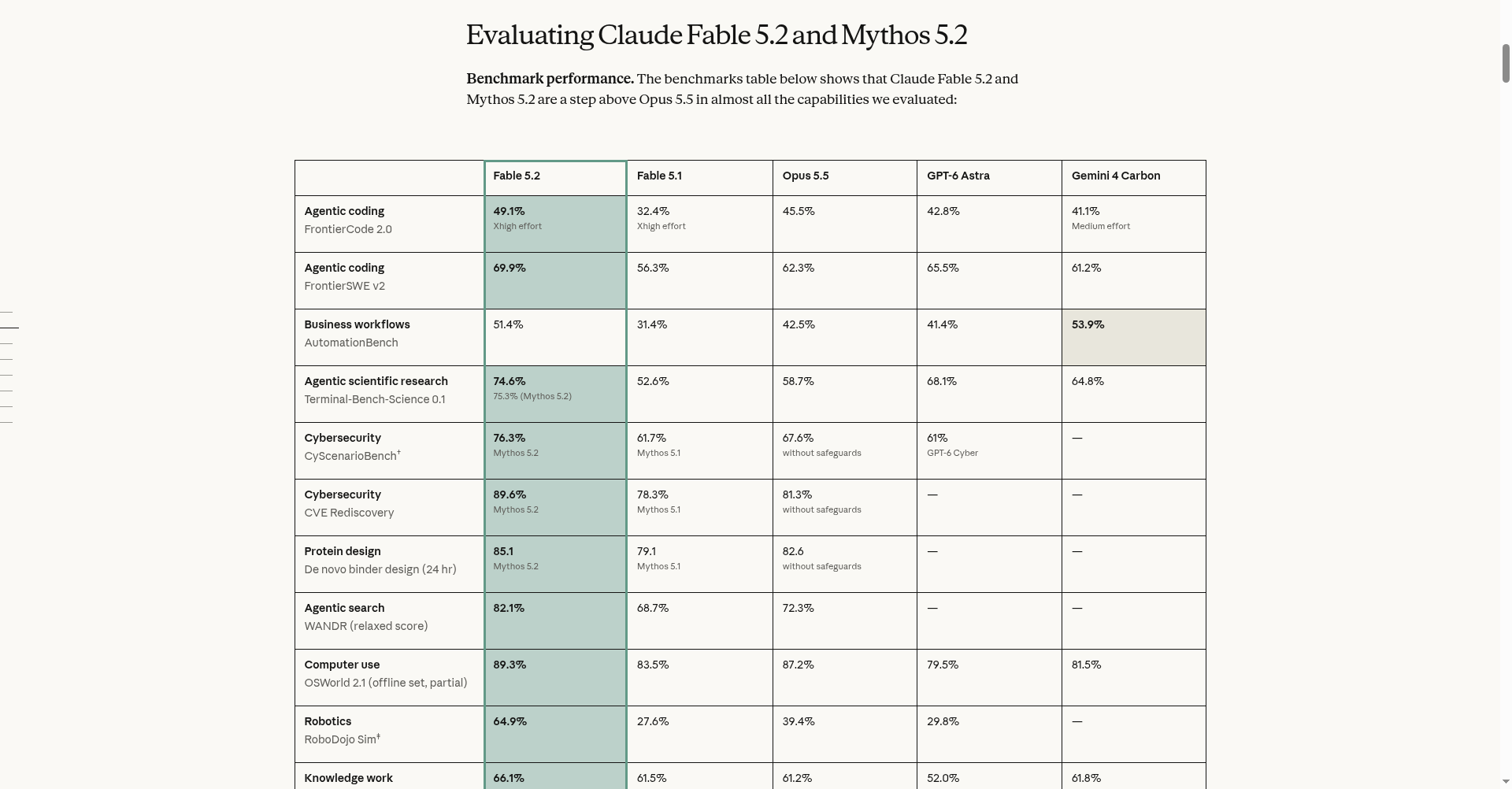
The November 9 announcement publishes a comparison table and says Fable 5.2 and Mythos 5.2 are “a step above Opus 5.5 in almost all the capabilities we evaluated.” Scores for Fable 5.2, Fable 5.1, and Opus 5.5 are with safeguards on unless otherwise noted, and each model’s highest-available effort is used unless otherwise noted. Selected official figures (Opus 5.5 in parentheses):
- FrontierCode 2.0: 49.1% at Xhigh effort (Opus 5.5: 45.5%)
- FrontierSWE v2: 69.9% (62.3%)
- AutomationBench: 51.4% (42.5%). Gemini 4 Carbon is listed higher, at 53.9%.
- Terminal-Bench-Science 0.1: 74.6% for Fable 5.2, 75.3% for Mythos 5.2 (Opus 5.5: 58.7%)
- WANDR, relaxed score: 82.1% (72.3%)
- OSWorld 2.1, offline set, partial: 89.3% (87.2%)
- Humanity’s Last Exam, with tools: 74.2% (67.7%)
- Chartography, no tools: 73.4% (64.4%)
- AA-Briefcase v1.1: 66.1% rubric / 1785 Elo for Fable 5.2, versus 61.2% rubric / 1800 Elo for Opus 5.5—one of the rows where Opus leads on the Elo figure
- Remote Labor Index: 41.3% at High effort (21.3%)
The same post also emphasizes cost per task, not just headline scores. On FrontierCode 2.0, Anthropic says Fable 5.2 at High effort scored about level with Opus 5.5’s best result (45.3% vs. 45.5%) for roughly half the cost per task, then reached 49.1% at Xhigh. On WANDR, it says Fable 5.2 at Medium effort matches Opus 5.5’s top score for about 40% of the cost per task. On Humanity’s Last Exam, it says Fable 5.2 at Low effort matches Opus 5.5’s top score for less than one-tenth of the cost per task. These are Anthropic’s published figures, not independent re-runs by us. Methodology details are in the Fable 5.2 and Mythos 5.2 system card.
Practical differences beyond the scoreboard
Two operational details matter as much as benchmarks. First, official Fable 5.2 docs say the model requires 30-day data retention and is not available under zero data retention unless Anthropic expressly authorizes it. The Opus 5.5 announcement states that Opus 5.5, like previous Opus models, is available with zero data retention. If your contract or compliance policy depends on ZDR, that alone can decide the comparison.
Second, default effort is higher on Fable 5.2 (high vs. Opus 5.5’s medium), and Fable’s base token price is already double. Combined, a casual “just switch the model ID” change can raise spend even when a given benchmark claims a lower cost per successful task at a carefully chosen effort level. Official docs also warn that forced tool use (tool_choice of any or tool) returns a 400 error on Fable 5.2, and that temperature, top_p, and top_k should be omitted.
On speed, testers quoted in the announcement found Fable 5.2 and Mythos 5.2 generate outputs up to 30% faster than the 5.1 generation. That is a 5.2-vs-5.1 claim, not a direct Fable-vs-Opus 5.5 latency comparison; both current model pages still list comparative latency as moderate.
Should you switch from Opus 5.5?
Stay on Opus 5.5 if your workload is typical software engineering or knowledge work, you already like its results at medium-to-max effort, or you need zero data retention. That is the default Anthropic recommends.
Try Fable 5.2 if Opus 5.5 still falls short on hard, long-running jobs—multi-hour agents, deep research, or analysis that has to land as a finished artifact—and you can accept double the base token price plus 30-day data retention. Use the effort parameter rather than leaving every request at Fable’s default of high, and consider Batch API rates when latency is not the constraint. If your use case is specialized defensive security or life-sciences work that Fable’s safeguards block, the official path is Mythos 5.2 through Anthropic’s verification programs, not a general-access Fable API key.
Primary official links: the November 9 Fable 5.2 and Mythos 5.2 announcement, the Opus 5.5 announcement, the Fable 5.2 model docs, the Opus 5.5 model docs, the model-selection guide, and API pricing.
Sources verified Nov 12, 2026 (Pacific Time): Anthropic, “Introducing Claude Fable 5.2 and Claude Mythos 5.2,” Nov 9, 2026; Anthropic, “Introducing Claude Opus 5.5,” Sep 22, 2026; Claude API docs: Claude Fable 5.2; Claude API docs: Claude Opus 5.5; Claude API docs: Choosing the right model; Claude API docs: Pricing; Anthropic, Claude Fable 5.2 and Mythos 5.2 System Card.