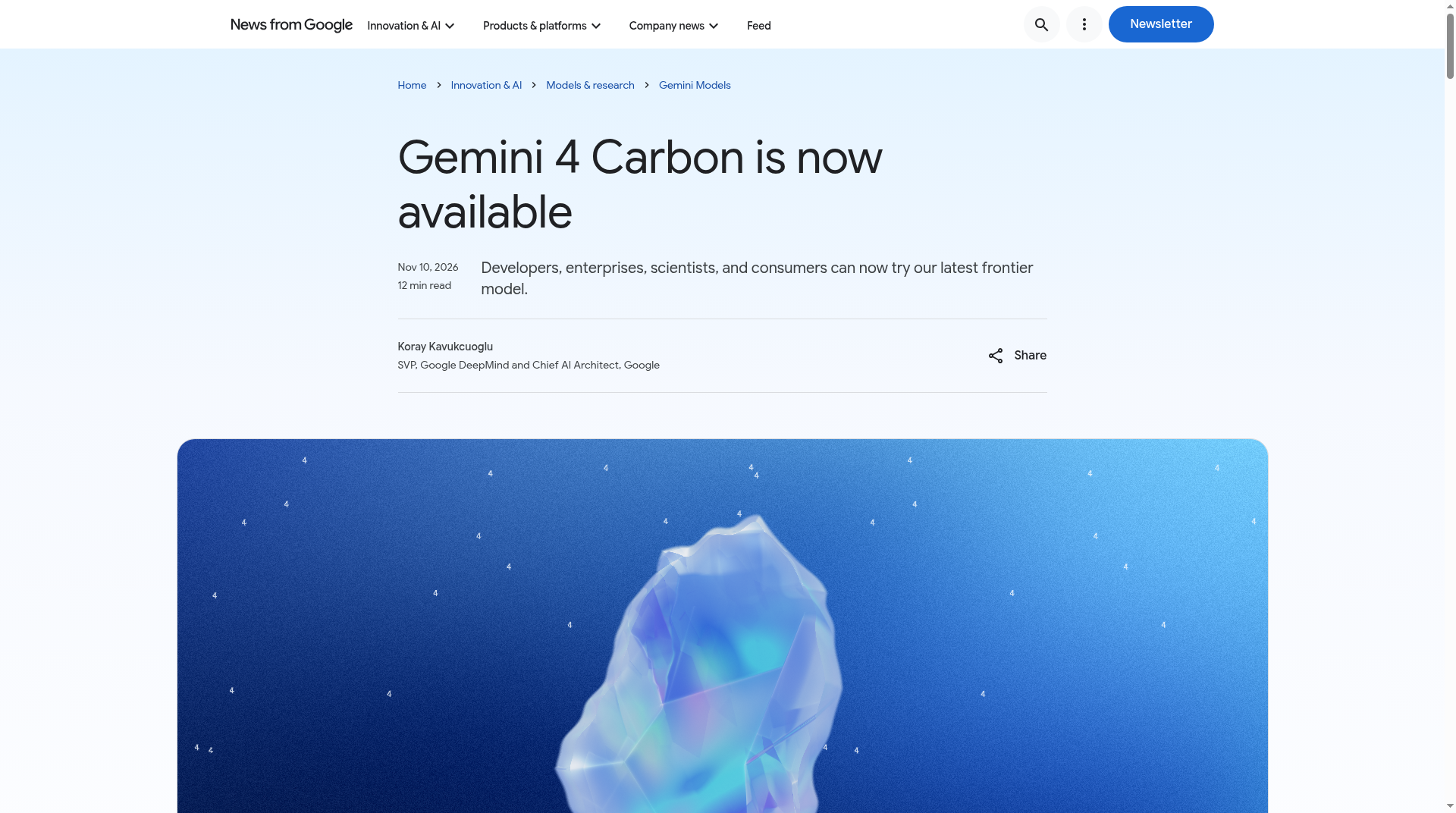
Gemini 4 Carbon is Google DeepMind’s latest frontier Gemini 4 model. Google announced it on October 28, 2026 and opened general access on November 10, 2026. The official description is a model for long-horizon agentic work across knowledge work, software engineering, scientific reasoning, and cybersecurity. It is based on Gemini 4 Argon. The Gemini API model code is gemini-4-carbon.
Carbon vs. Argon: what Google says is different
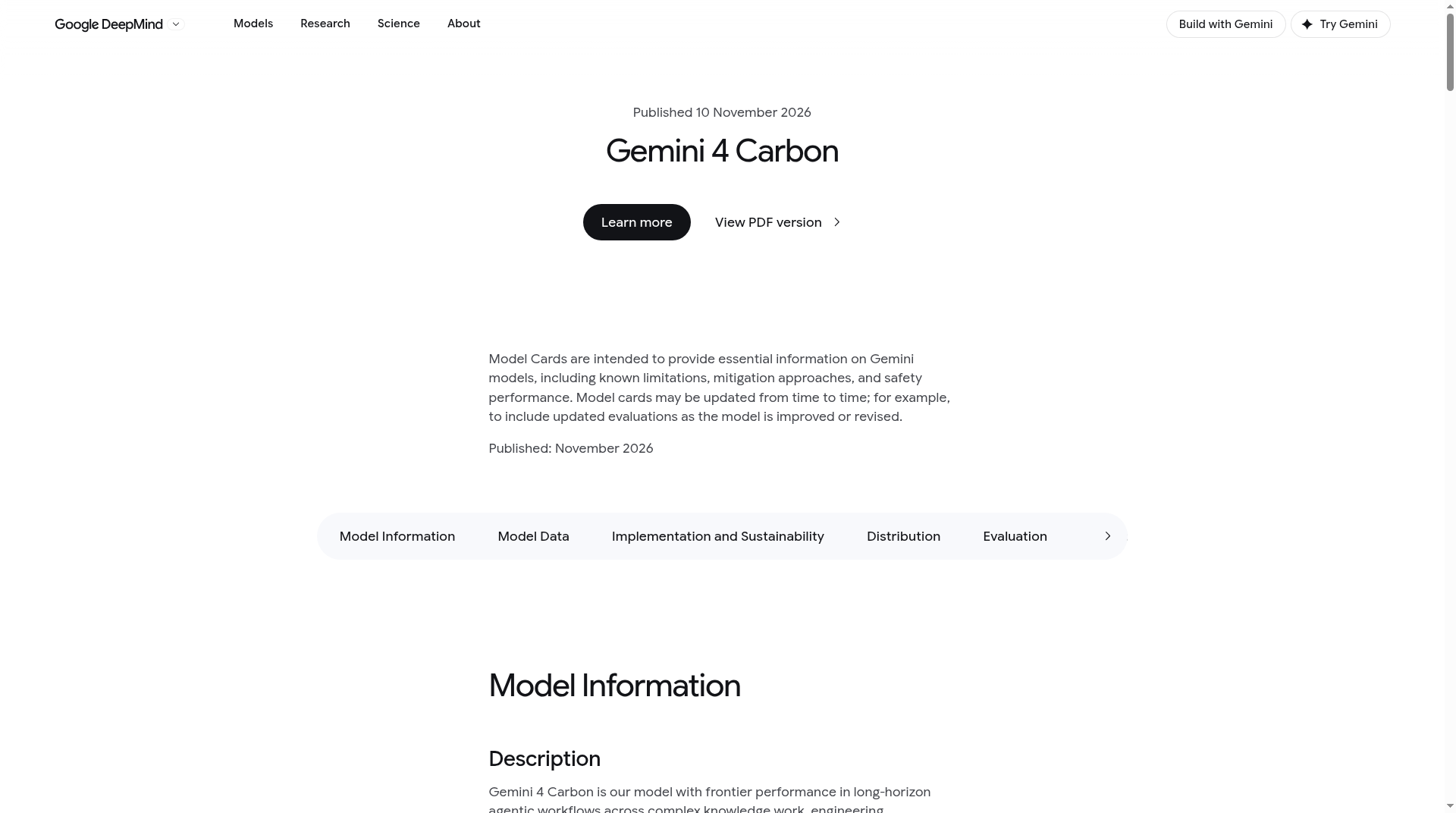
Google is not positioning Carbon as a replacement for Argon. The November 10 availability post says Argon “remains the ideal choice for the majority of software engineering and knowledge work,” while Carbon is for tasks that “test the limits of a model’s intelligence”—complex multi-step coding and debugging, and open-ended scientific research—using more tokens than Argon to explore, reason, and run longer verification loops. The Gemini 4 Carbon model card adds that Carbon uses more thinking tokens than Argon, with configurable thinking levels to trade off quality, latency, and cost.
Official Gemini API docs describe thinking support at low, medium, and high levels. The model card’s known limitations include the usual foundation-model issues (such as hallucinations), occasional slowness or timeouts, and higher token use at higher thinking levels. The stated knowledge cutoff is March 2026, with the caveat that some domains may be less current.
Specs from the official model docs
According to the Gemini 4 Carbon model page on Google AI Studio / Gemini API docs:
- Model code:
gemini-4-carbon - Inputs: text, image, video, audio, and PDF
- Output: text (image generation, audio generation, and the Live API are listed as not supported)
- Context window: a unified input-and-output limit of 1,048,576 tokens
- Max output: 65,536 tokens for default synchronous requests, or up to 1,048,576 tokens with long decode
- Also listed as supported: code execution, computer use, implicit context caching only (explicit caching is not supported), file search, function calling, grounding with Google Search and Maps, structured outputs, URL context, batch API, and flex inference
The model card matches the 1M combined input/output window and says outputs are text.
Who can use Gemini 4 Carbon
Access depends on the product and the subscription tier. The November 10 post and the model card together list these official channels:
- Developers: the Gemini API paid tier in Google AI Studio and Android Studio. Official pricing docs state Carbon is not available on the Free tier, and that every token processed is billed, including thinking tokens and, when grounding is used, internal tool system instructions and function declarations. Google AI Ultra subscribers can also try it in Google Antigravity and AI Studio.
- Enterprises: Gemini for business via the API or model dropdown, Google Antigravity, or CodeMender.
- Everyday users: the Gemini app and AI Mode in Search, if you have Google AI Ultra. It is rolling out to those Ultra subscribers.
- Scientists and researchers: Google says a program that already offered Argon in Antigravity (up to 10,000 scientists, highest usage tier free for six months) is expanding to include Carbon. Applications remain open, with weekly rolling onboarding, subject to eligibility, capacity, and selection.
- Cybersecurity defenders: specialized “Carbon for cyber” access is offered to verified defenders through Google’s Fairwind Program, on a rolling basis. Google says it first gave Carbon to a set of defenders about two weeks before the November 10 general launch.
Official API pricing
The availability post says Carbon launched at the same introductory price as Argon: $2 per million input tokens and $10 per million output tokens. After the introductory period ends on November 30, 2026, the public-access Carbon price becomes $4 per million input tokens and $20 per million output tokens. That post notes the higher rate “applies to the Carbon model intended for public access only.” The October 28 announcement also said cached input tokens are priced at 95% off the input token price.
The Gemini Developer API pricing page (Standard, paid tier, USD per 1 million tokens) agrees with those dates and adds more detail. Output prices include thinking tokens. Context caching on the Standard tier is listed at $0.10 through November 30, 2026, and $0.20 starting December 1, 2026, implicit caching only. Batch and Flex tabs list intro rates of $1 input / $5 output, rising to $2 / $10 on December 1. Priority is listed at $3.60 / $18 intro, then $7.20 / $36. Always recheck the live pricing page before you budget; published rates can change.
Official benchmarks (treat vendor scores as vendor scores)
The model card publishes a comparison table “as of October 2026,” and says cybersecurity scores reflect performance when the model is accessed through the Fairwind Program. Selected official figures for Gemini 4 Carbon (with the card’s Argon numbers in parentheses):
- Artificial Analysis Intelligence Index v5.0: 59 (Argon 50). The October 28 blog also said Carbon ranked #1 on that updated index at 59.
- Terminal-Bench 4.0 (AA): 65.2% (Argon 57.1%)
- Zapier AutomationBench: 53.9% (Argon 51.3%)
- GraphWalks, 256k to 1M BFS (F1): 96.2% (Argon 84.2%)
- Cybersecurity, Fairwind access: SEC-bench Pro 88.2%, ExploitGym 54.8%, CWE-bench 71.0%
The November 10 post adds workflow-oriented claims: Carbon ranks #1 on CursorBench 4.0, Perplexity’s WANDR, and Zapier’s AutomationBench “at more than 2X lower cost per task compared to the next best external model.” On a new Multimodal Knowledge Agent (MKA) benchmark Google says it launched with Artificial Analysis, Carbon ranks #2 and is “more than 6X lower in average cost per task compared to the top performing model.” These are Google’s published figures, not independent re-runs by us.
Google also previewed a /swarm feature in Google Antigravity that turns one prompt into a coordinated team of agents, with Carbon assigned to roles that need deeper reasoning.
Safety notes and limitations
Google published a separate Gemini 4 Carbon Safety and Security report alongside the launch posts. High-level claims from those official pages include stronger misuse and prompt-injection mitigations than Argon, a 0% attack success rate on Gray Swan’s Indirect Prompt Injection benchmark in the figures Google reported, and a 92% pass rate on an internal 375-task agentic honesty benchmark (70% for Argon). The model card still lists residual risks: hallucinations, jailbreak work that is “continually” being improved, and possible slowness or higher token use. Specialized dual-use cybersecurity capabilities are limited to verified defenders in Fairwind; this article does not cover offensive techniques.
Should you switch from Argon?
Stay on Argon if your workload is typical software engineering or knowledge work and you care about speed and token cost. Official docs describe Argon as the efficient Gemini 4 frontier model, with faster responses and lower token spend per turn than Carbon on complex coding, agentic, math, and science tasks.
Try Carbon if you already have paid Gemini API, Gemini for business, or Google AI Ultra access and you have hard, long-running jobs—multi-step debugging, dense document and data analysis, scientific reasoning, or (if you qualify) defensive security work through Fairwind. Budget for thinking tokens, and remember the introductory Standard rates are scheduled to double on December 1, 2026.
Primary official links: the November 10 availability post, the October 28 announcement, the model card, model docs, and API pricing.
Sources verified Nov 10, 2026 (Pacific Time): Google blog, “Gemini 4 Carbon is now available,” Nov 10, 2026; Google blog, “Introducing Gemini 4 Carbon,” Oct 28, 2026; Google DeepMind, Gemini 4 Carbon model card (published 10 November 2026); DeepMind Gemini models page; Gemini API docs: Gemini 4 Carbon; Gemini Developer API pricing.