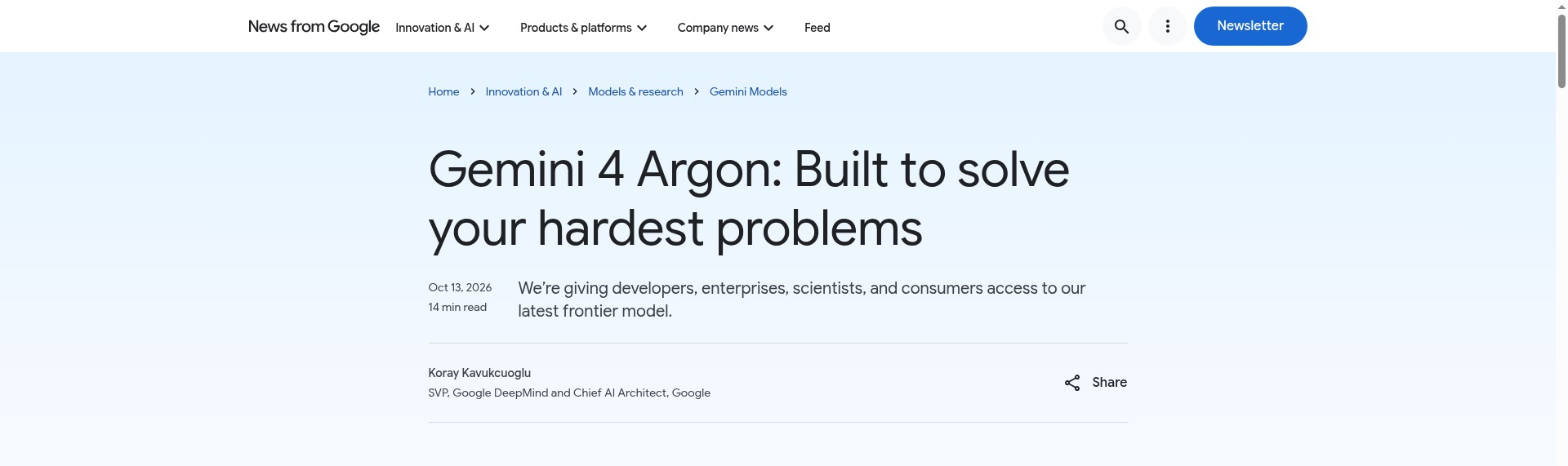
Google’s Gemini 4 Argon is the company’s latest frontier model, aimed at long-horizon coding, enterprise knowledge work, science, and defensive cybersecurity. After a phased Fairwind rollout to trusted cyber defenders in late September 2026, Google opened broader access on October 13, 2026. This guide summarizes what is new, who can use it, and the introductory API pricing — verified against blog.google and ai.google.dev.
What’s new in Gemini 4 Argon
Per Google’s model posts and the Gemini API “latest model” documentation, Argon (gemini-4-argon) is positioned as Google’s most capable publicly described Gemini 4-class model for hard, multi-step work. Highlights include:
- Unified 1M-token window: Input, thinking, and output share one 1,048,576-token limit via the Gemini API.
- Long decode: A single response can go beyond the prior ~64K output ceiling (up to 1M minus input), with background execution / continuation hops for very long generations.
- Tunable thinking levels:
low,medium(default), andhightrade latency/cost against depth on hard math, science, and coding tasks. - Agentic workflows: Strong emphasis on Antigravity / Managed Agents for multi-step engineering and knowledge work; agentic video understanding is described as generally available.
- Domain focus: Software engineering, legal/finance-style knowledge work, science, robotics demos, and cybersecurity defense capability (with separate Fairwind access without cyber guardrails for trusted defenders).
Performance claims Google is highlighting
Google reports leading or state-of-the-art results on several public and partner benchmarks in its September 30 announcement, including DeepSWE v1.1 for long-horizon software engineering, the Vals Index (finance/coding/legal/tax economic-impact style evals), Harvey’s Legal Agent Benchmark, Zapier AutomationBench, LVBench for long video understanding, and CWE-bench for vulnerability remediation. Treat vendor-reported scores as directional: always re-check the model card and independent evals for your workload.
Who can use it
As of Google’s October 13, 2026 availability posts, access breaks down roughly as follows:
Developers
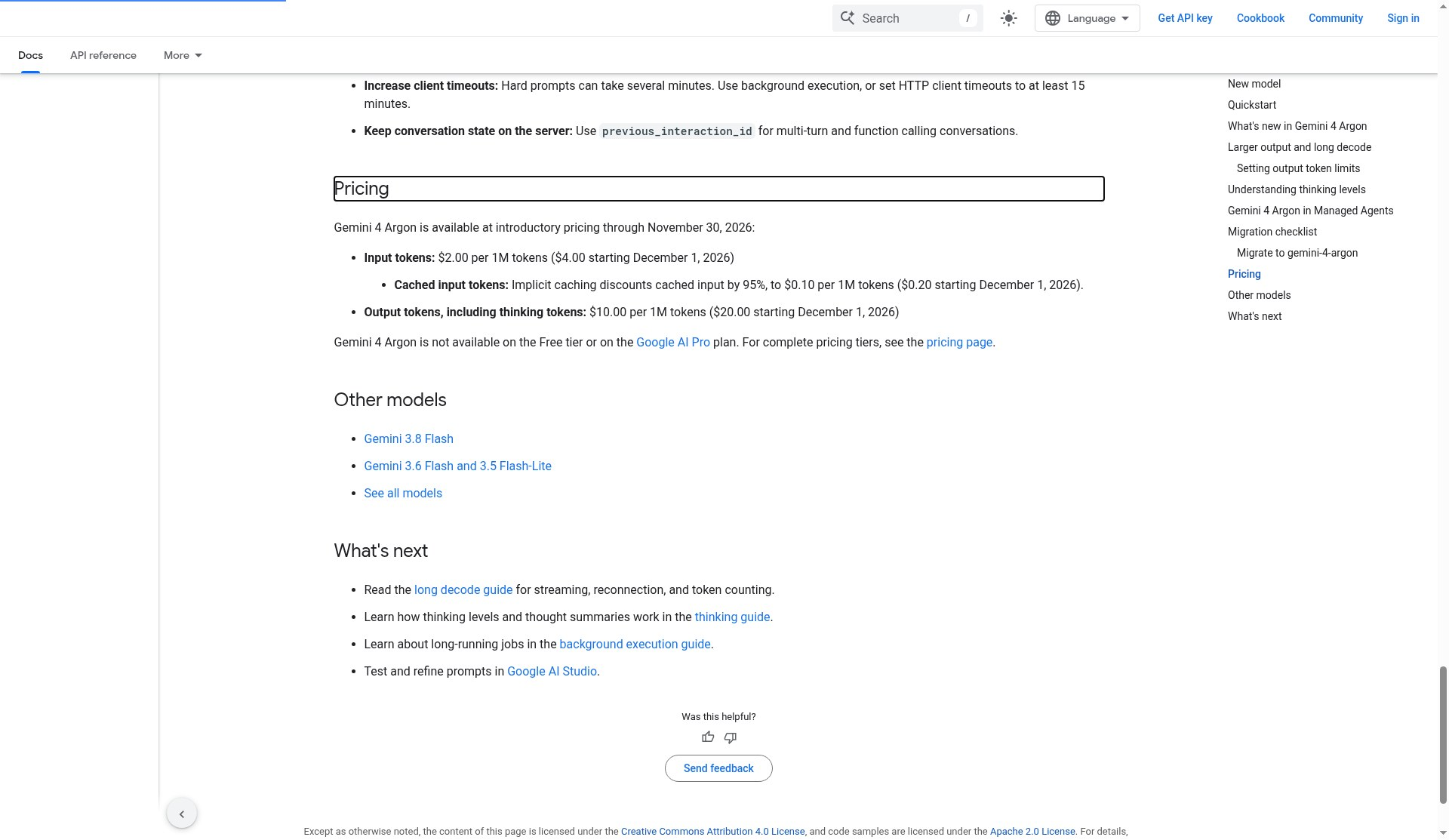
Build with the paid tier of the Gemini API in Google AI Studio and Android Studio. Model ID: gemini-4-argon. Google states Argon is not available on the Free tier (and not on the Google AI Pro plan for API access per ai.google.dev pricing notes).
Enterprises
Available via Gemini for business, the API, and Google Antigravity, according to blog.google.
Gemini app / Search users
Google AI Ultra and Pro subscribers can use Gemini 4 Argon in the Gemini app and AI Mode in Search. Ultra subscribers also get Antigravity / AI Studio pathways called out in the launch posts.
Scientists and cyber defenders
Google opened applications for selected scientists to receive Antigravity’s highest usage tier free for six months (eligibility and capacity limits apply). Trusted cybersecurity organizations can apply to the Fairwind Program for Argon access without cyber guardrails, after Google’s phased pre-release process.
Introductory pricing (API)
Google’s blog and ai.google.dev list the following introductory rates for the public Argon model through November 30, 2026:
- Input: $2.00 per 1M tokens (rises to $4.00 on December 1, 2026)
- Output (including thinking tokens): $10.00 per 1M tokens (rises to $20.00 on December 1, 2026)
- Cached input (implicit caching): 95% off input — about $0.10 per 1M during the intro window ($0.20 afterward)
Explicit context caching APIs used on older models are not supported on Argon; Google points developers to implicit caching for long prompts. Pricing pages can change — confirm on ai.google.dev before budgeting production traffic.
Practical tips if you are migrating
- Switch the model string to
gemini-4-argon. - Raise
max_output_tokensif you previously capped below ~32K; thinking can consume headroom. - Pick a thinking level with evals (
mediumis the documented default). - For outputs beyond 64K tokens, use background execution / long-decode continuation as documented.
- Increase client timeouts; hard prompts may run for minutes.
Safety and responsible use notes
Google describes expanded misuse/jailbreak defenses, prompt-injection resistance, and agent misalignment monitoring for Argon, plus a phased release aligned with voluntary U.S. government pre-release processes. Cyber offense capabilities are intentionally gated; consumer and standard API access keep cyber guardrails. Organizations doing defensive security research should use official Fairwind channels rather than attempting to bypass product safeguards.
FAQ
Is Gemini 4 Argon free?
Not on the Gemini API free tier. Consumer access is tied to Google AI Pro/Ultra subscriptions in the app/Search pathways Google listed. Limited scientific Antigravity grants are application-based.
How long does intro pricing last?
Through November 30, 2026, then the higher $4 / $20 per 1M input/output rates apply (per Google’s footnotes).
Where should I read the primary docs?
Start with blog.google posts “Introducing Gemini 4 Argon” (Sep 30, 2026) and “Gemini 4 Argon is now available for everyone” (Oct 13, 2026), plus ai.google.dev Gemini API pages for gemini-4-argon, thinking levels, long decode, and pricing.
Does this article cover Cloud Vertex pricing?
Figures above follow Google’s Gemini API / blog introductory pricing. Enterprise Google Cloud / Vertex SKUs can differ — check Google Cloud documentation for contract rates.
Sources verified Oct 14, 2026 (Asia/Shanghai): blog.google Gemini 4 Argon announcement and availability posts; ai.google.dev “What’s new in Gemini 4 Argon” / pricing sections. Product availability can vary by country and account type.